


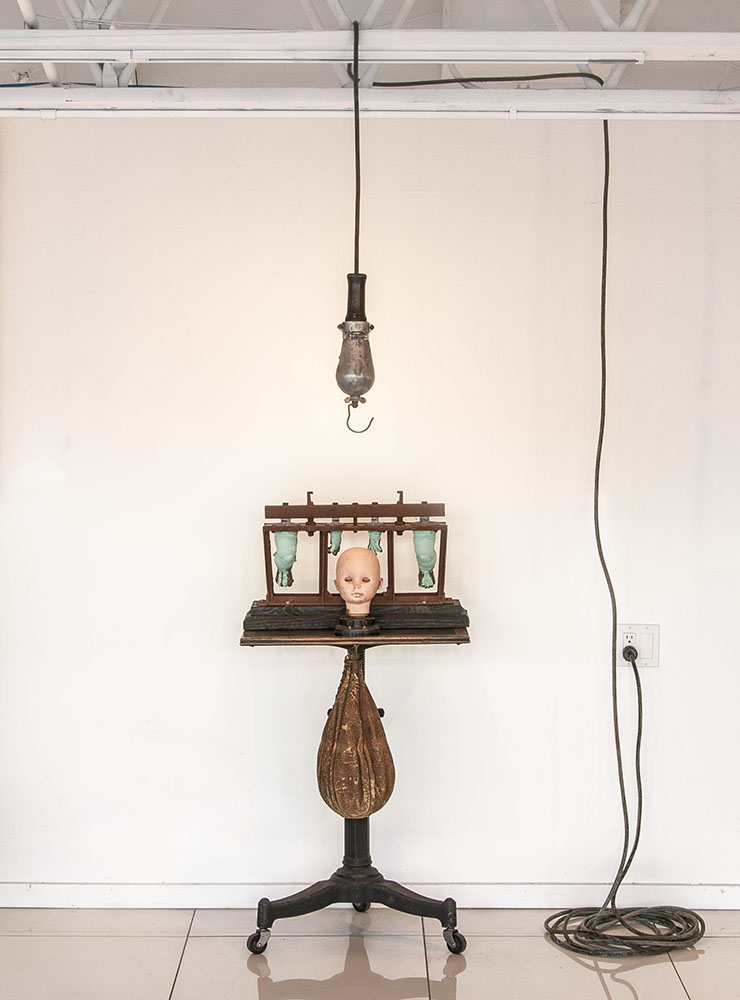
The Future of Healthcare in America?
A Rolling Conundrum
(tag 703)
2019
Assemblage (23" x 17" x 42" Total height is 7'–9' total height with pulley and cord)
- cast iron rolling industrial stand
- boxer's punching bag
- iron cage containing doll leg and hands
- eyeless doll head with wire protruding from neck
- antique Weston Milli-Volt Meter
- mechanic's drop light with pulley and electrical cord
Exhibition History:
California Heritage Museum, April 27 – November 8, 2019
Description:
The Future of Health Care in America? is one of Lou D’Elia’s “Rolling Conundrums,” a series of freestanding assemblage sculptures built on vintage wheeled industrial bases. The rolling base is central to the concept of the series: these are problems that move, that travel, that show up everywhere.
The piece asks the viewer to consider what happens when a human being enters a system designed for processing, not for healing. Every material choice is deliberate. The base is a cast iron industrial stand on casters, the kind of thing you would find in a factory or a machine shop, never in a place of care. Sitting on top of it is an aged, deflated boxer’s punching bag that serves as the patient’s body. It has absorbed its hits.
Above the body, a small iron cage holds disassembled doll parts, legs and limbs suspended like specimens or spare parts awaiting cataloguing. A single eyeless doll’s head with a wire protruding from its neck rests on the platform of an antique Weston milli-volt meter. The meter is a quietly devastating detail. It is an instrument built to register the faintest electrical signals, measurements so small they barely register on most scales, and here it bears the weight of the only element in the piece that still has a face, that still holds something like human presence. The implication is precise: whatever remains of the individual in this system is something that can only be detected in the smallest possible units of measure. The face is small and fragile and utterly dwarfed by the industrial apparatus surrounding it.
Hanging from above is a mechanic’s drop light, the kind used in auto repair shops. This is one of the sharpest gestures in the work. It transforms the clinical gaze into something borrowed from a garage bay. The patient is not being examined. The patient is being inspected. The electrical cord runs visibly down the wall to a standard outlet, a practical necessity that also reads as a statement: this entire apparatus depends on a system, on infrastructure, on someone deciding to keep the power on.
D’Elia created this piece in 2019, but its questions have only grown more pressing. As healthcare becomes increasingly systematized and algorithmic, as the time a physician spends with an individual patient continues to shrink, as insurance costs push meaningful coverage further beyond the reach of ordinary Americans, and as Congress actively debates cutting or entirely eliminating funding for Medicare and the network of federal assistance programs that millions depend on simply to walk through a doctor’s door, the piece asks whether we are building a country in which the patient is no longer seen as a whole person but as a collection of parts on a line, and in which the line itself may soon be shut down for anyone who cannot pay the price of admission. The question mark in the title is doing real work. It is not a declaration. It is a warning that still waits for an answer.