

Double Whammy (Black & Gay)
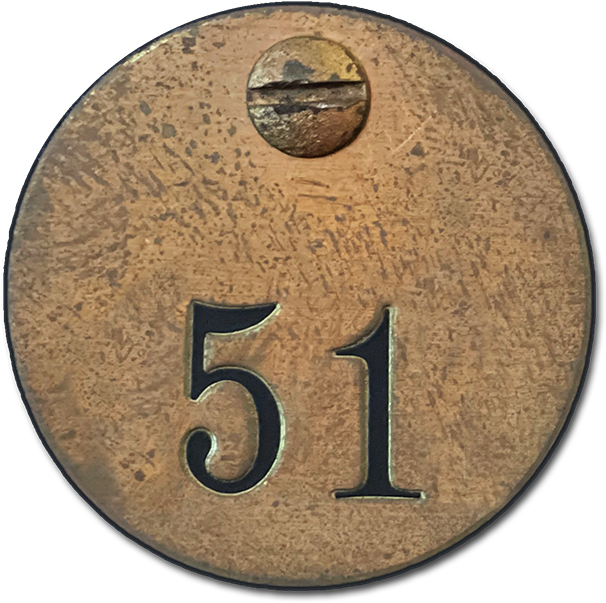
(tag 594)
2026
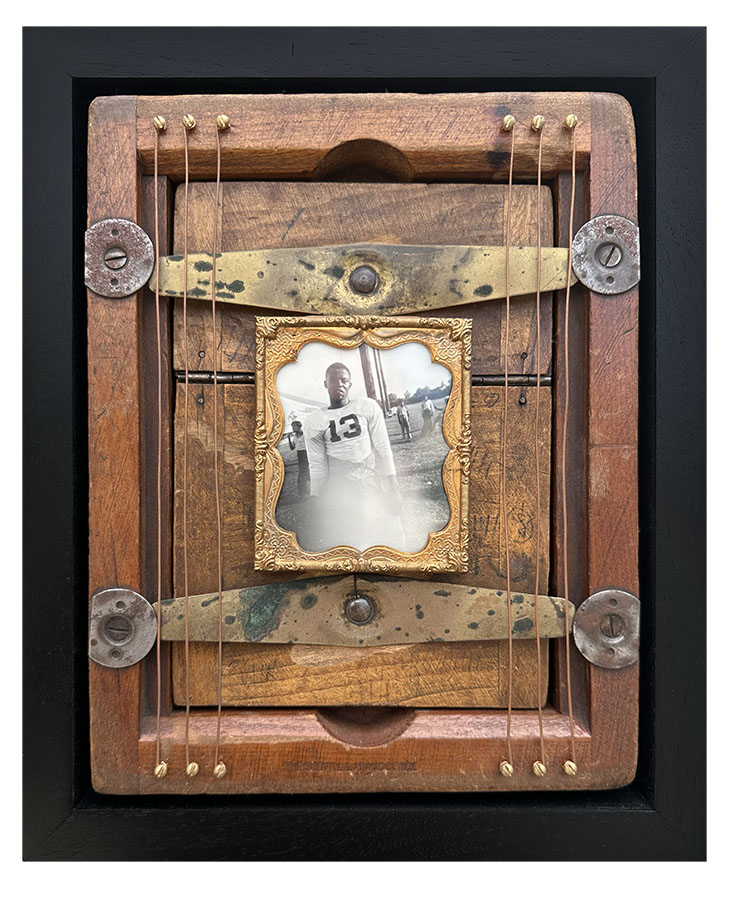
Assemblage (10.75” x 8.75” x 1.5”)
- antique photographic contact printing frame
- copper wire
- copper screws
- vintage Victorian pressed gold foil daguerreotype frame
- vintage circa 1950s gelatin silver photograph
- A vintage photograph of a young African American man, his football jersey bearing the number 13, rests within a Victorian-era pressed gold foil daguerreotype frame. Copper screws anchor vertical copper wires at top and bottom, like the tuning pegs of an instrument that has not yet found its pitch.
Description:
An antique contact printing frame serves as the base of this artwork. It was designed to transfer an image from a photographic negative onto photosensitive paper through pressure and light. Here it becomes a metaphor for the way identity is transferred onto a marginalized person by external forces.
The young man looks directly outward, composed and self-possessed. His jersey number, 13, carries the cultural freight of superstition and bad luck, and the title names the compounded weight of that freight: to be Black and gay in mid-century America was to carry not one but two designations that a fearful society coded as unlucky, unnatural, unwelcome.
The vertical copper wires are metaphors for prison bars. Racism builds a kind of prison for minority groups out of polite refusal and inherited assumption, out of neighborhoods with invisible borders and locker rooms where certain silences are understood. The young man looks out at us, steady and unbowed, and in that refusal to lower his eyes lives the quiet defiance of every soul who was told that the metaphorical prison cell, the ghettoization, the exclusion from opportunities and full participation in mainstream society was for his own protection.
The Victorian frame holding the photograph suggests the long historical lineage of that exclusion, its roots older than the photograph itself, while the copper wire holds everything in tension, beautiful and taut, stretched between fixed points with no slack to give.
That this piece was completed in 2026 is not incidental. The vintage photograph and Victorian hardware remind us that these structures of exclusion are old, but the assemblage speaks in the present tense because the machinery of racism has never been dismantled. In our current moment, racism persists not as some residual stain slowly fading in the wash of progress but as a force actively renewed, amplified now by far-right political movements that cloak white nationalism in the language of restoration, as though making America great were somehow separable from making America white again. The metaphorical prison bars have been polished and given new names, rebranded as policy, as border control, as tradition, as law, but the young man knows better. He knew in 1950. He would recognize this still.