


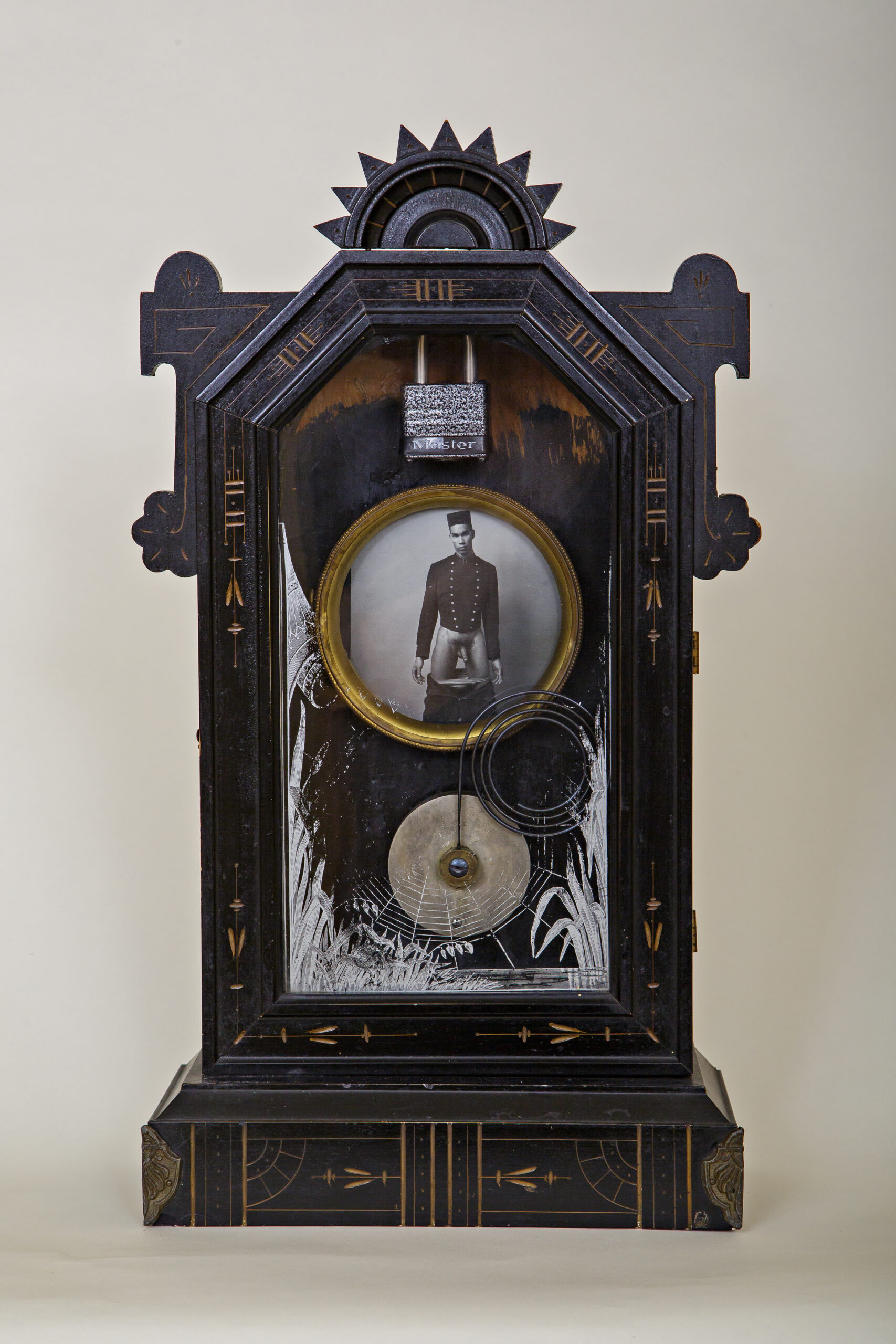
Master
(tag 21)
2019
Assemblage (19.25” x 10.25” x 5”)
- vintage clock case
- clock face ring
- Master padlock
- photograph
Description:
D’Elia’s assemblage Master confronts the layered history of servitude, sexuality, and power with the precision of a psychological excavation. The work inhabits a Victorian-era clock case, its ornate geometry repurposed as a vessel for cultural memory and critique. Time, here, is both container and witness, its face replaced by a haunting photographic image of a young, nude African American bellhop. The figure stands rigid in his livery, a uniform of service, yet his nakedness transforms him into an object, stripped of agency, reduced to spectacle.
The image is encircled by a halo-like gold ring, once the face of the clock. Rather than sanctifying the figure, this golden halo emphasizes the uneasy contradiction between reverence and exploitation. Above it hangs a cold, functional padlock branded Master, a blunt symbol of control, ownership, and the denial of freedom. The word itself resonates with the vocabulary of slavery, echoing centuries of racial domination, while simultaneously evoking the eroticized trope of the “master–servant” dynamic.
D’Elia deepens this uneasy tension with his subtle interventions on the glass. Painted cobwebs sprawl across the surface, suggesting time’s accumulation, the entrapment of history, and the persistence of systemic injustice. The webs also speak to psychological stagnation: traumas left unacknowledged, silenced but still present. Within this suspended moment, the clock no longer measures hours but bears witness to the endurance of a racialized past.
At its core, Master operates as a meditation on objectification and memory. The Victorian clock case, an artifact of respectability and domestic order, becomes the stage for unsettling truths. By encasing the bellhop within this frame, D’Elia reveals how Black male bodies have been historically circumscribed by narratives of labor, service, and erotic projection. Yet the work is not merely accusatory; it holds space for resistance. The figure’s upright stance, his direct gaze, suggests an enduring humanity that refuses complete erasure.
The result is a psychologically charged tableau: a work that collapses histories of slavery, minstrelsy, and fetishization into a single haunting image. Master insists we confront the ways in which race, desire, and power remain entangled, as persistent as the cobwebs across its glass, reminders that the past is never past, but locked into the very structures of our present.