

Copyright © Lou D'Elia. All rights reserved.
SEPARATION of Church & State (or the lack thereof)
(tag 100)
2026
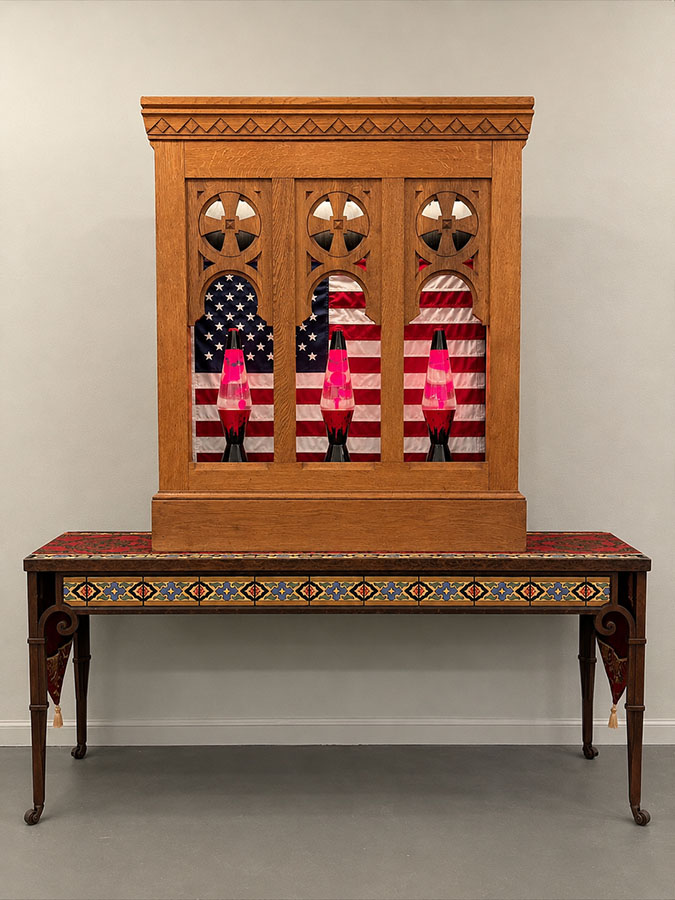
Assemblage (67.25" x 19" x 75")
- 19th Century Gothic Communion rail gate
- Bushere & Sons custom iron and tile table
- Embroidered cloth table runner
- Three Lava lamps with blood red wax
- American Flag
Exhibition History:
California Heritage Museum, "Some Assemblage Required", July 11-November 15, 2026
Description:
Fifteen years in the making, this work was delayed not by uncertainty of vision but by the artist’s insistence on waiting for the exact elements capable of carrying the full weight of its meaning. At the center of the piece stands a mid-19th-century Gothic oak altar rail gate, once used as both a communion barrier and a threshold into the sacristy, now positioned at the front of a large cabinet. Inside, three lava lamps filled with custom blood-red wax rise and fall behind a softly lit American flag. The flag remains visible, but it is partially obscured by a religious threshold. That is the point. The altar rail gate operates here not as decorative remnant but as a symbol of access, exclusion, permission, hierarchy, and institutional control. The lava lamps, seductive and sinister in equal measure, transform the domestic language of kitsch and nostalgia into vessels of injury and foreboding. The wax does not explode. It slowly rises and falls, thickens, and returns, suggesting a society drifting toward danger while mistaking what it sees for something merely interesting. The table, designed and constructed specifically for this work by Bushere and Sons, lends the whole the dignity of hand-made furniture, its iron, tile, and red-and-gold embroidered runner introducing a ceremonial undercurrent that allows the piece to read, at first, as reverent, even patriotic. Only gradually does its truth begin to register.This is by design. D’Elia conceived the work as a commentary on what he sees as a dangerous deterioration of one of the most essential principles in American democracy: that religion and government must not be fused. For many early settlers, America represented escape from religious persecution and state-imposed belief. That history, in the artist’s view, is not a side note; it is one of the moral foundations of the country. Much of the danger in political and democratic erosion does not arrive with clear-eyed clarity. It arrives dressed as normalcy, ritual, familiarity, heritage, and sentiment. This is why D’Elia insisted the work be beautiful. Beauty is part of the trap. The oak gate is handsome. The softly lit flag is visually moving. The lava lamps are mesmerizing. D’Elia has long been drawn to objects that once served systems of order, devotion, and hierarchy, using them not to celebrate nostalgia but to expose the psychological and emotional residue they continue to hold. The work is not anti-religion. It is a warning against the collapse of necessary boundaries, and against the danger that arises when religious authority and state power begin to merge in a democracy that depends upon pluralism, freedom of conscience, and protection from imposed belief. It asks whether the United States is beginning to betray one of its own founding protections, and whether we still possess the moral seriousness to defend that principle before the damage becomes irreversible.