Memories of Hidden Love

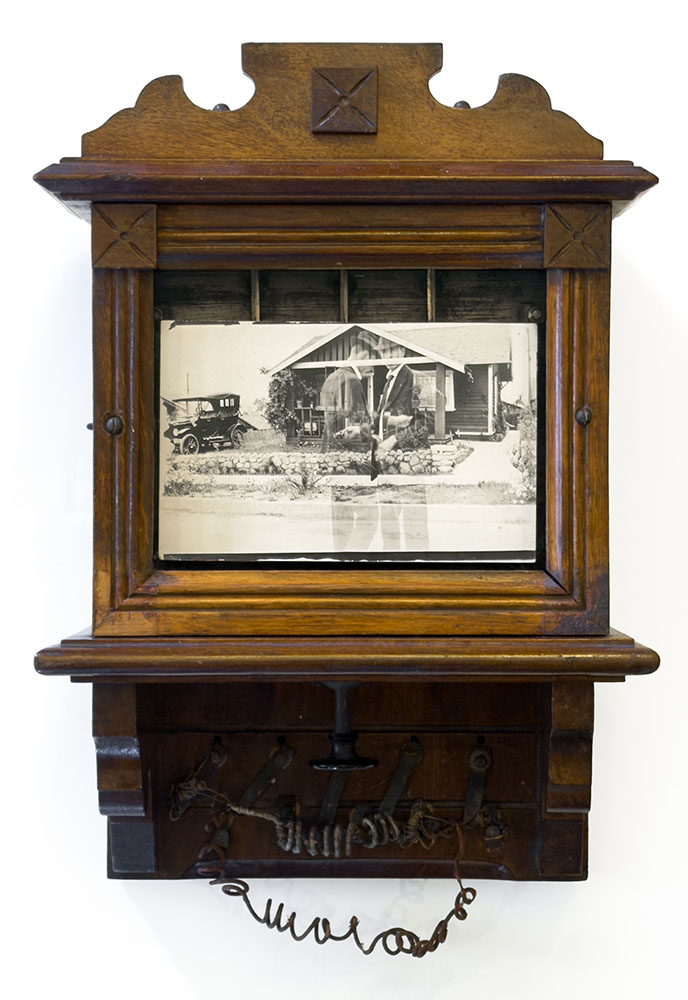
Memories of Hidden Love. A vintage double-exposed photograph of two men and their home has been placed inside an antique annunciator, a device once used to discretely signal unseen servants from other rooms in the house. The two men appear and vanish within the same emulsion, present and gone in the same breath. They are a truth that could be lived but never publicly announced.

The annunciator becomes a potent metaphor for coded communication, secrecy, and the hidden structures of domestic life, a device designed so that those who served could be summoned without ever being seen. Here, it holds two men who loved each other under the same roof and with the same silence.

The electrical wire trailing below the panel hangs disconnected, inert. A circuit never completed. A signal never sent. Not because the love wasn’t real, but because the outside world wasn’t ready to receive it.
What survives is a single photograph in which two men who built a home and shared a life could finally stand together, visible to anyone who looks closely enough. That so many still cannot step out of the frame and into the open is the quiet grief this work refuses to let go of.

With tenderness and psychological precision, the artist turns a historical object of silent summons into a meditation on queer intimacy, invisibility, and emotional survival. Even now, some can never speak of the one they love most.

The Future of Healthcare in America?

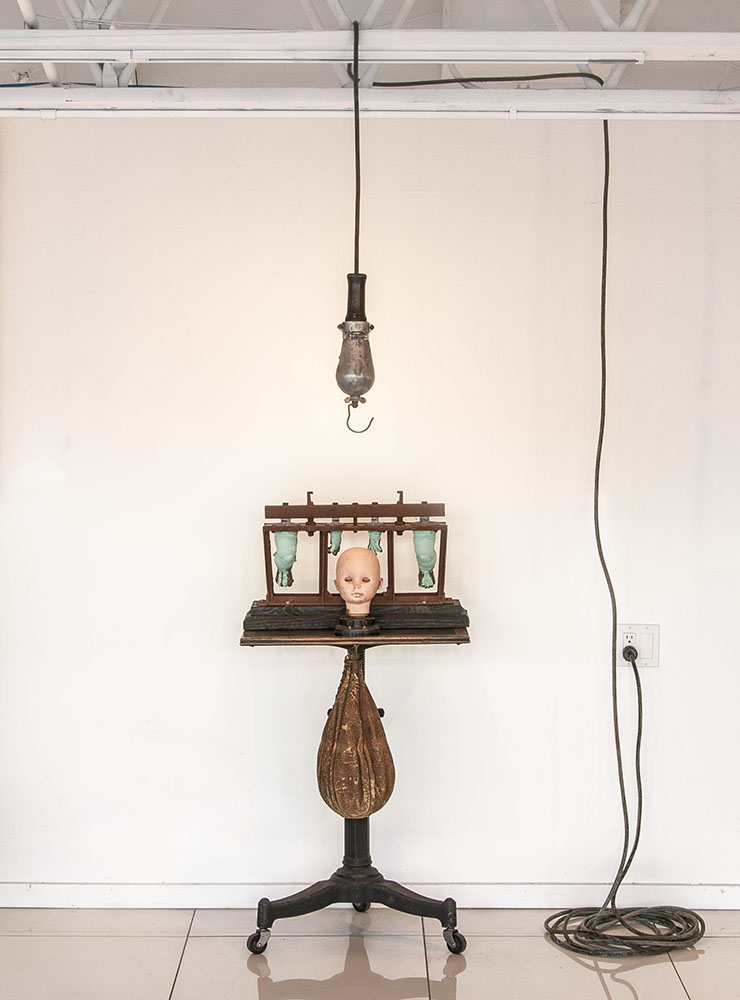
The Future of Health Care in America? is one of Lou D’Elia’s “Rolling Conundrums,” a series of freestanding assemblage sculptures built on vintage wheeled industrial bases. The rolling base is central to the concept of the series: these are problems that move, that travel, that show up everywhere.

The piece asks the viewer to consider what happens when a human being enters a system designed for processing, not for healing. Every material choice is deliberate. The base is a cast iron industrial stand on casters, the kind of thing you would find in a factory or a machine shop, never in a place of care. Sitting on top of it is an aged, deflated boxer’s punching bag that serves as the patient’s body. It has absorbed its hits.

Above the body, a small iron cage holds disassembled doll parts, legs and limbs suspended like specimens or spare parts awaiting cataloguing. A single eyeless doll’s head with a wire protruding from its neck rests on the platform of an antique Weston milli-volt meter. The meter is a quietly devastating detail. It is an instrument built to register the faintest electrical signals, measurements so small they barely register on most scales, and here it bears the weight of the only element in the piece that still has a face, that still holds something like human presence. The implication is precise: whatever remains of the individual in this system is something that can only be detected in the smallest possible units of measure. The face is small and fragile and utterly dwarfed by the industrial apparatus surrounding it.

Hanging from above is a mechanic’s drop light, the kind used in auto repair shops. This is one of the sharpest gestures in the work. It transforms the clinical gaze into something borrowed from a garage bay. The patient is not being examined. The patient is being inspected. The electrical cord runs visibly down the wall to a standard outlet, a practical necessity that also reads as a statement: this entire apparatus depends on a system, on infrastructure, on someone deciding to keep the power on.

D’Elia created this piece in 2019, but its questions have only grown more pressing. As healthcare becomes increasingly systematized and algorithmic, as the time a physician spends with an individual patient continues to shrink, as insurance costs push meaningful coverage further beyond the reach of ordinary Americans, and as Congress actively debates cutting or entirely eliminating funding for Medicare and the network of federal assistance programs that millions depend on simply to walk through a doctor’s door, the piece asks whether we are building a country in which the patient is no longer seen as a whole person but as a collection of parts on a line, and in which the line itself may soon be shut down for anyone who cannot pay the price of admission. The question mark in the title is doing real work. It is not a declaration. It is a warning that still waits for an answer.

SEPARATION of Church & State (or the lack thereof)

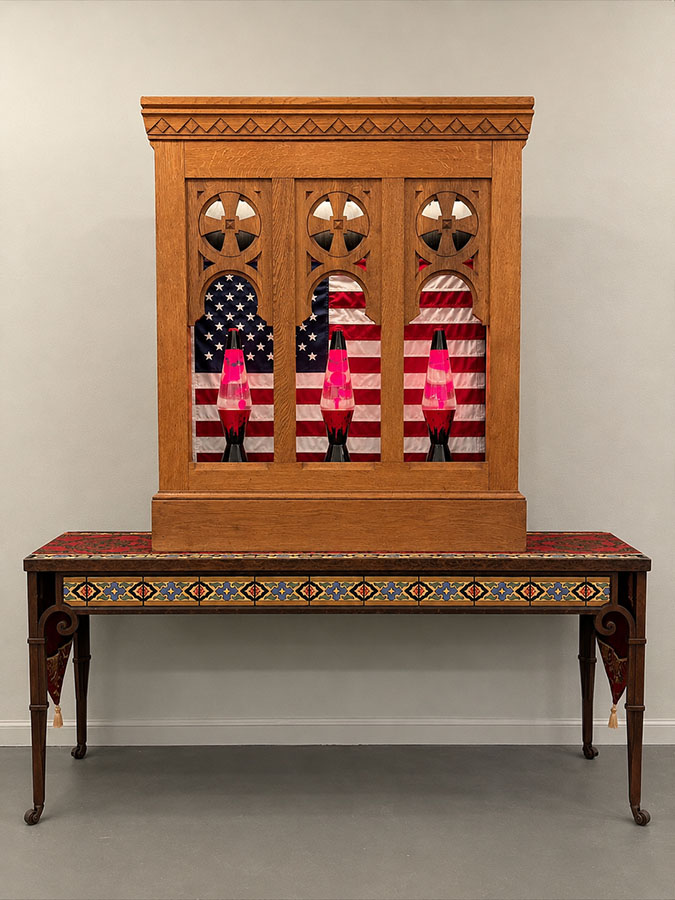
Fifteen years in the making, this work was delayed not by uncertainty of vision but by the artist’s insistence on waiting for the exact elements capable of carrying the full weight of its meaning. At the center of the piece stands a mid-19th-century Gothic oak altar rail gate, once used as both a communion barrier and a threshold into the sacristy, now positioned at the front of a large cabinet. Inside, three lava lamps filled with custom blood-red wax rise and fall behind a softly lit American flag. The flag remains visible, but it is partially obscured by a religious threshold. That is the point. The altar rail gate operates here not as decorative remnant but as a symbol of access, exclusion, permission, hierarchy, and institutional control. The lava lamps, seductive and sinister in equal measure, transform the domestic language of kitsch and nostalgia into vessels of injury and foreboding. The wax does not explode. It slowly rises and falls, thickens, and returns, suggesting a society drifting toward danger while mistaking what it sees for something merely interesting. The table, designed and constructed specifically for this work by Bushere and Sons, lends the whole the dignity of hand-made furniture, its iron, tile, and red-and-gold embroidered runner introducing a ceremonial undercurrent that allows the piece to read, at first, as reverent, even patriotic. Only gradually does its truth begin to register.

This is by design. D’Elia conceived the work as a commentary on what he sees as a dangerous deterioration of one of the most essential principles in American democracy: that religion and government must not be fused. For many early settlers, America represented escape from religious persecution and state-imposed belief. That history, in the artist’s view, is not a side note; it is one of the moral foundations of the country. Much of the danger in political and democratic erosion does not arrive with clear-eyed clarity. It arrives dressed as normalcy, ritual, familiarity, heritage, and sentiment. This is why D’Elia insisted the work be beautiful. Beauty is part of the trap. The oak gate is handsome. The softly lit flag is visually moving. The lava lamps are mesmerizing. D’Elia has long been drawn to objects that once served systems of order, devotion, and hierarchy, using them not to celebrate nostalgia but to expose the psychological and emotional residue they continue to hold. The work is not anti-religion. It is a warning against the collapse of necessary boundaries, and against the danger that arises when religious authority and state power begin to merge in a democracy that depends upon pluralism, freedom of conscience, and protection from imposed belief. It asks whether the United States is beginning to betray one of its own founding protections, and whether we still possess the moral seriousness to defend that principle before the damage becomes irreversible.

The Big What If

This artwork can be viewed as a reflection on the fragility of life and the inherent uncertainties that accompany human existence.

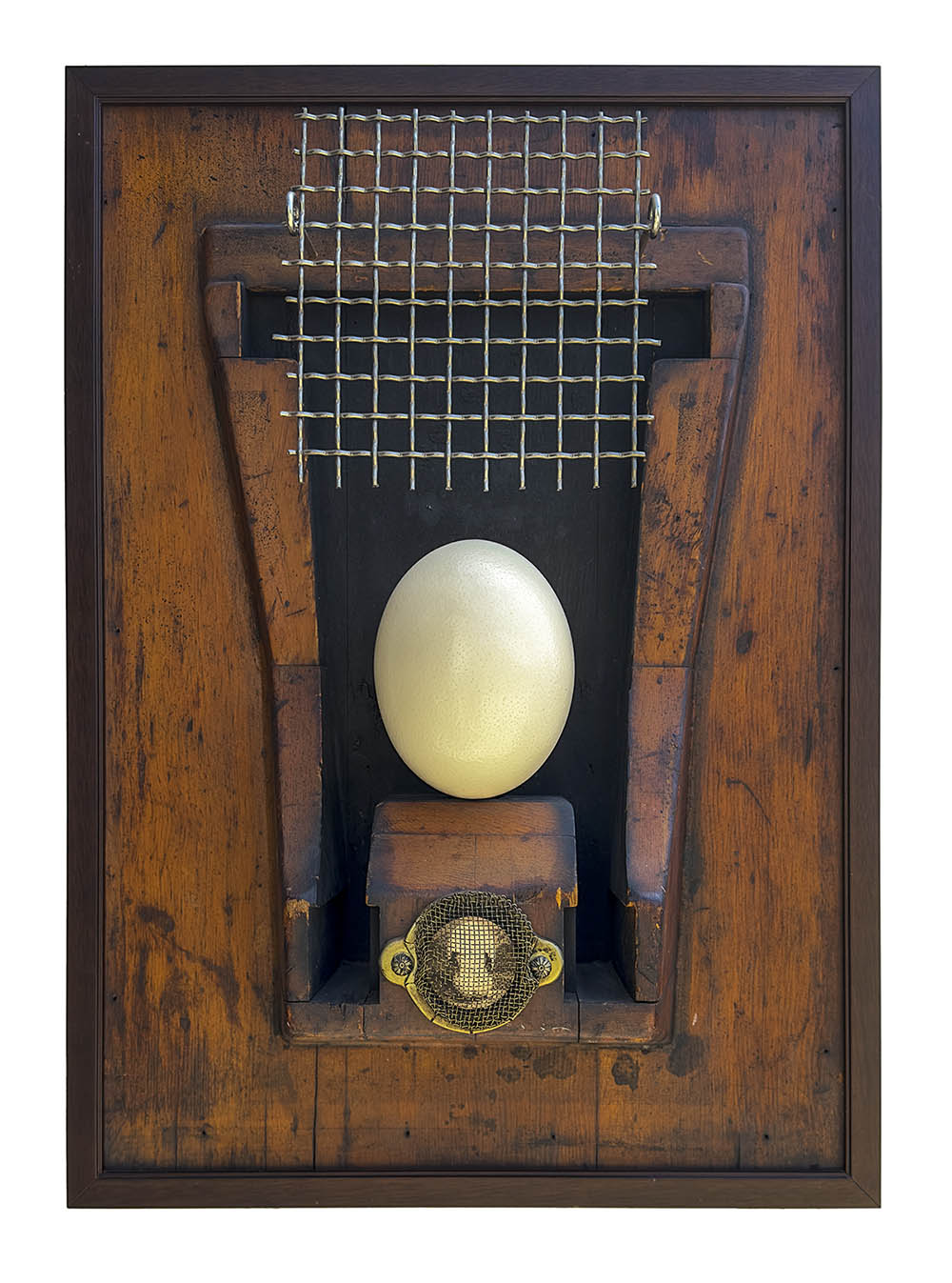
“The Big What If” was created using a fragment from an antique foundry mold suggestive of an oviduct, and a metal grate suspended by two eyehooks above an ostrich egg. At the bottom of the artwork is a photograph of a human being hatched from an egg. The photograph is framed using an antique car gas cap that is covered by a fragment from a screen filter.

The suspended metal grate over the fragile ostrich egg represents the delicate balance between strength and fragility in the human experience. This aspect of the artwork symbolizes the constant interplay between vulnerability and resilience in the human experience, illustrating how the two often coexist and influence one another.

Another interpretation of the suspended metal grate considers the ever-present threat of unpredictable events that can impact our lives. The grate’s position above the fragile ostrich egg symbolizes the potential dangers and unforeseen challenges that can arise at any time, reminding viewers of the uncertainties inherent in life.

The screen filter fragment covering the photograph of the human being hatched from an egg can be interpreted as a representation of the desire to safeguard the delicate and fragile aspects of human existence as one navigates the complexities of life. The screen fragment can also be viewed as a metaphor for the filtered perception of reality that humans often experience. This interpretation suggests that our understanding of ourselves and the world around us is not always direct or unobstructed but is instead influenced by various factors that can shape and distort our perceptions.

Mi Corazón

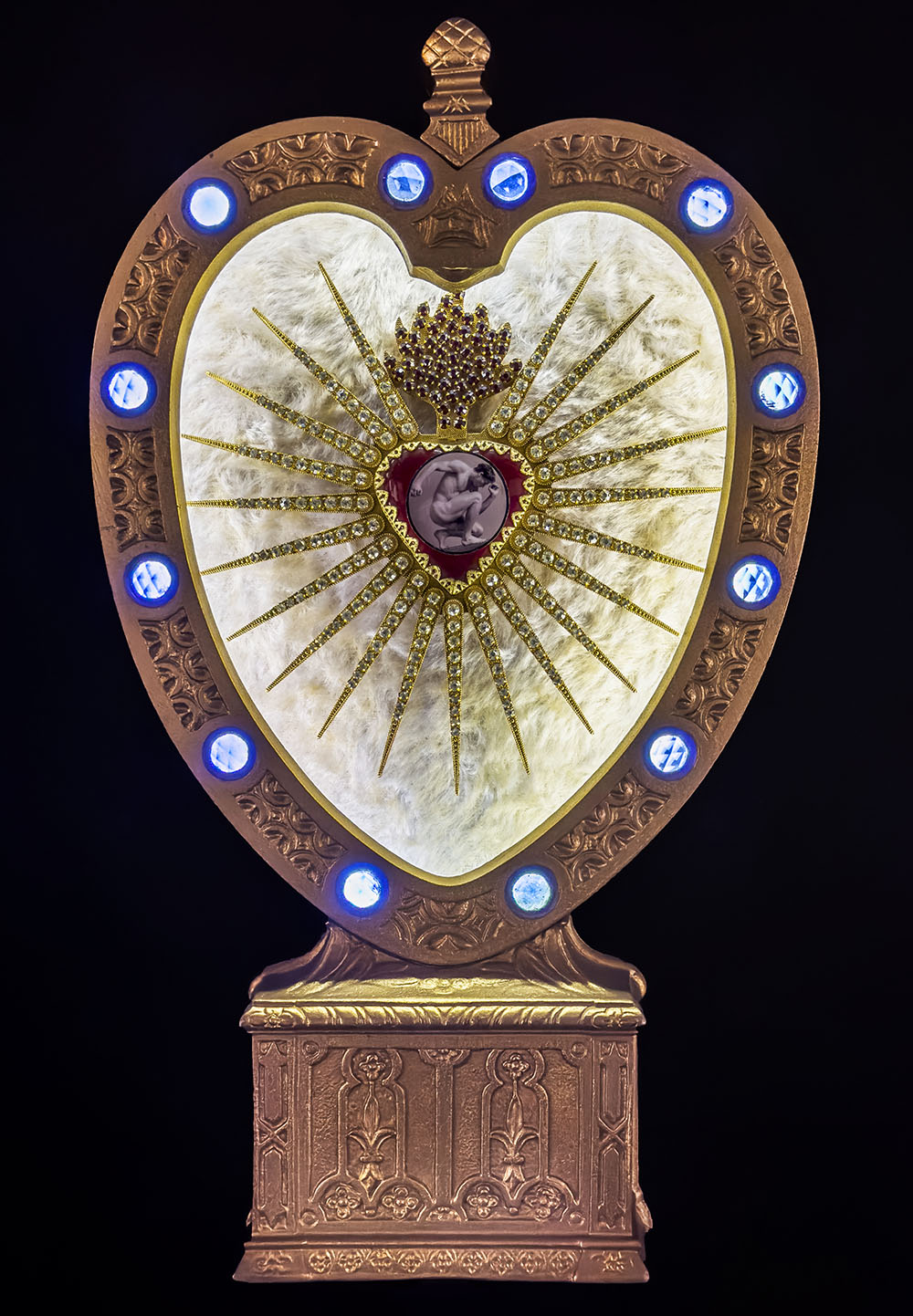
This artwork explores the meaning and significance of love and devotion. “Mi Corazón” represents the deeply personal and emotional connection between a lover and the object of their affection.  The use of a large metal heart, the white fur background, along with the inclusion of a nude portrait of the young man affixed to the bejeweled starburst Sacred Heart suggests a romantic and passionate relationship, with the overall artwork serving as a symbol of love and commitment. The fact that the figure is crouched projects a sense of vulnerability, while the neon-lit metal heart surrounding the figure suggests an intimate and protective environment.

With this piece, the artist is conveying that love, in all its forms, is a powerful and divine force that transcends the boundaries between the spiritual and material worlds.

As usual, the artwork is signed with the artist’s last name and an antique numbered tool tag.  This artwork is signed with tool tag #143.  143 is based on the number of letters in each word of the phrase  I (1), love (4), you (3).

A Very Old Game

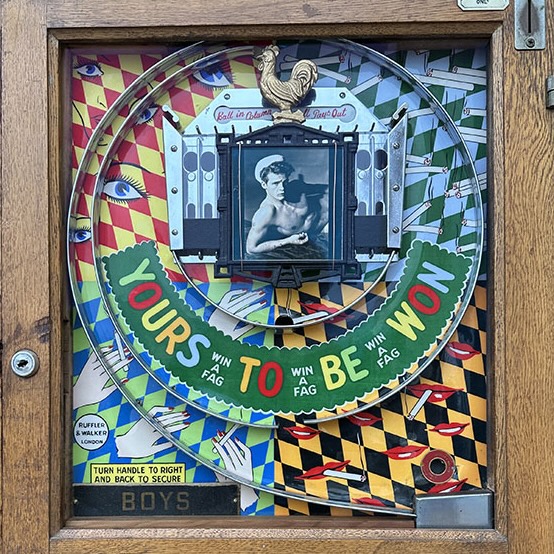
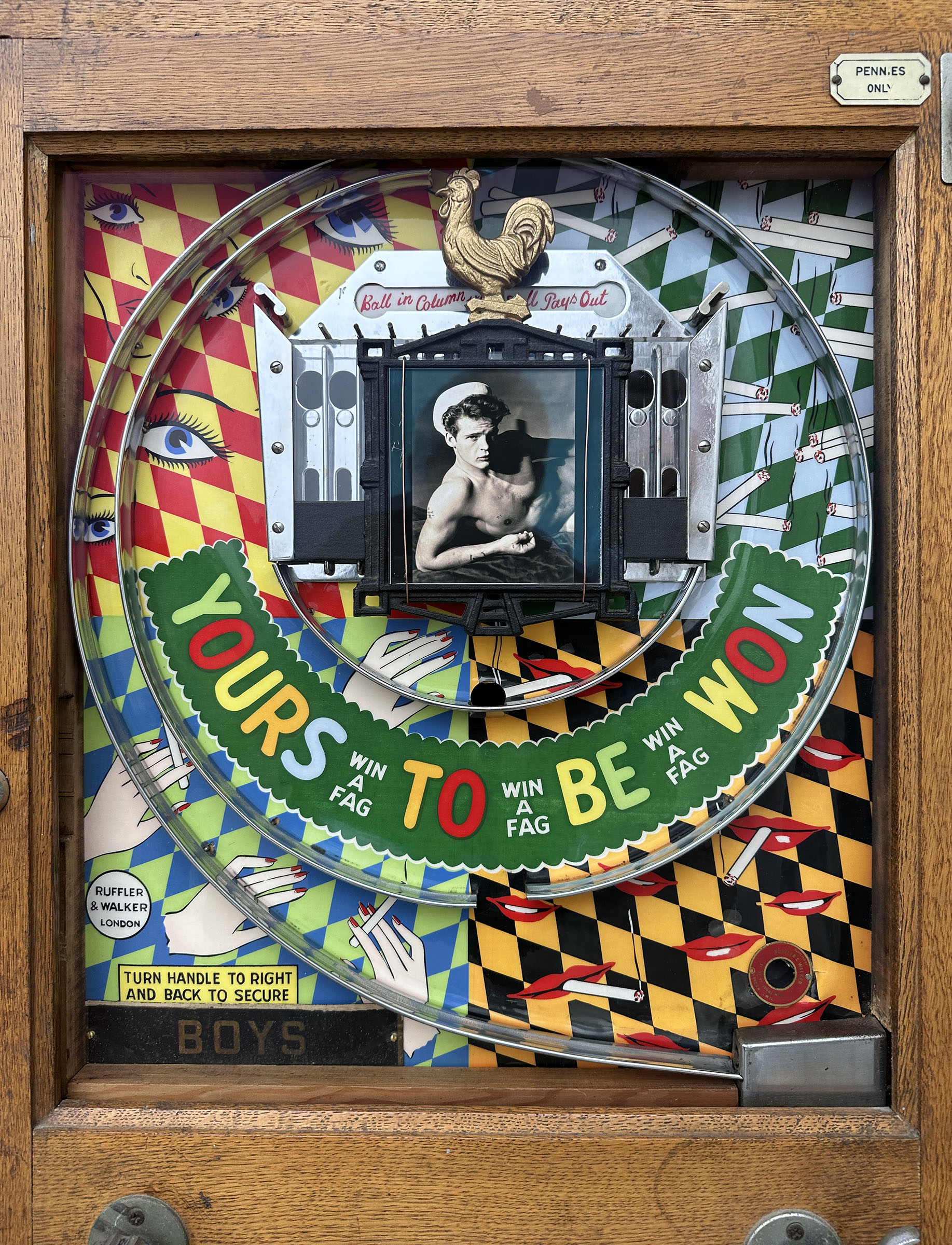
In contemporary society, political rhetoric has intensified the vilification of marginalized communities, employing derogatory rhetoric, stereotypes and tropes to fortify their in-group cohesion.

This artwork is a commentary on the more recent uptick in hate speech and tropes targeting the LGBTQ community. It’s a very old game, designed to marginalize and devalue the lives of its members and create a sense of loathing, fear and hate.

Detail
Detail – Click to Enlarge

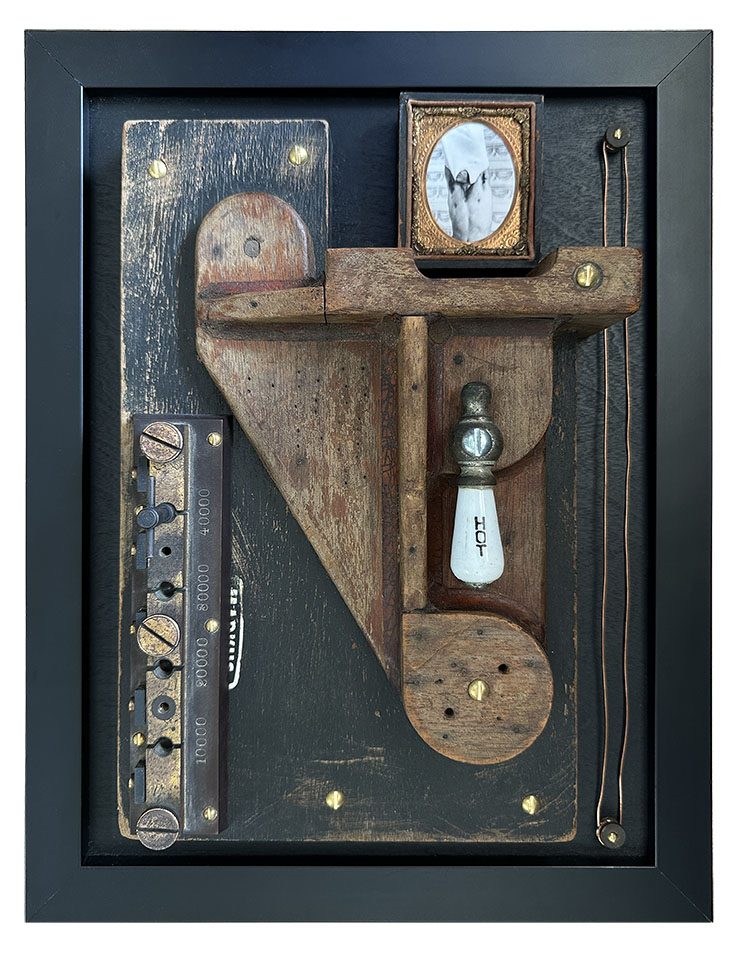
Peeking (Hot Water)

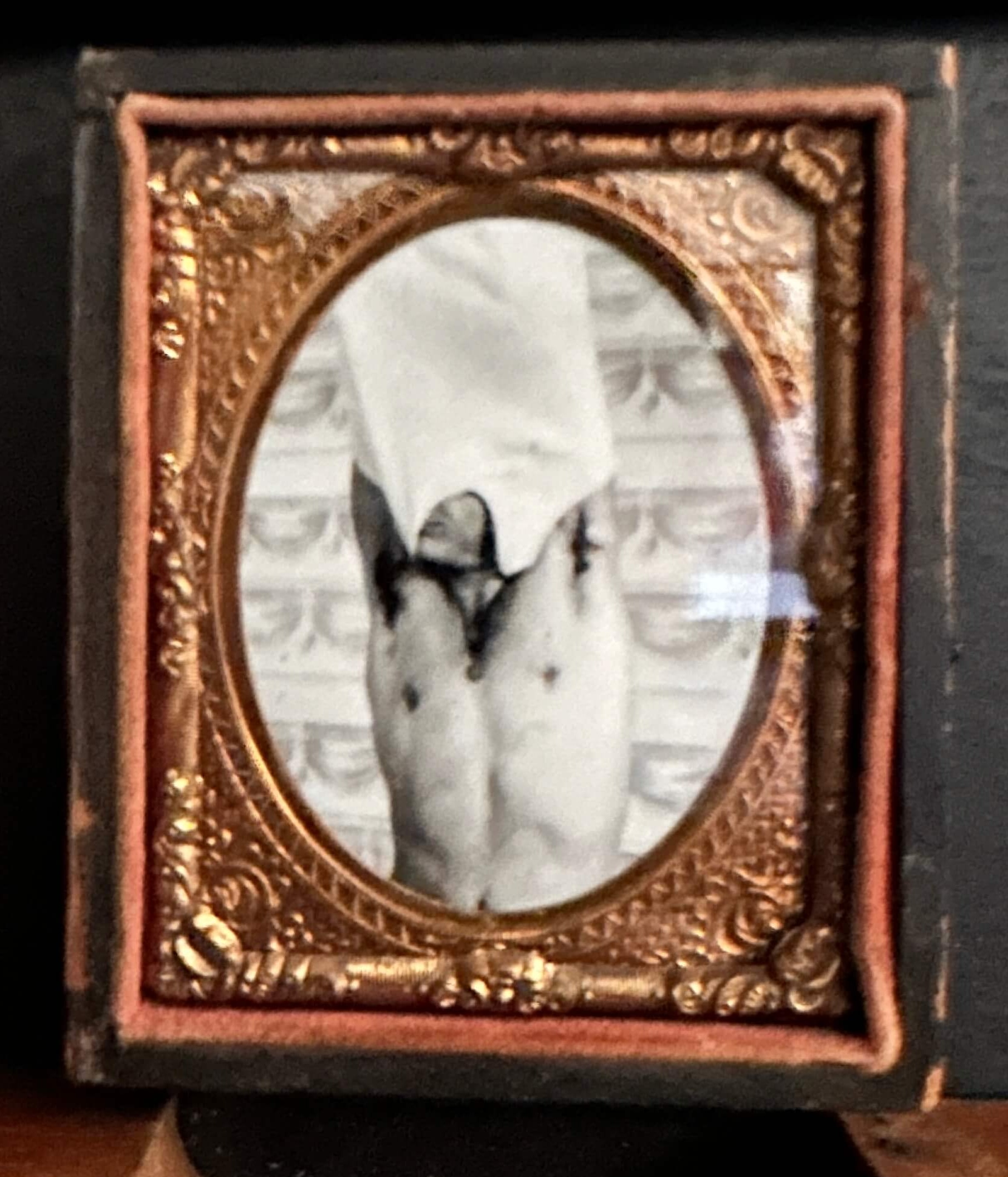
In this artwork D’Elia fuses playful visual puns with the charged undercurrents of adolescent awakening. A vintage photograph captures a young man mid-disrobing, frozen in that fleeting moment when vision is obscured and the viewer is given the illusion of invisibility.

Artwork Detail

The old porcelain “HOT” water tap handle and the fragment of an antique resistor box layer metaphor with innuendo: heat, resistance, and the risk of being caught in the act.

The weathered wood of a foundry mold anchors the composition, its industrial past reimagined in service of a more intimate, human narrative. Copper screws and wire trace connections between objects like neural pathways firing, echoing the sudden surge of hormones and electricity that mark the first jolts of desire.

D’Elia’s assemblage speaks with humor and candor about a shared but rarely admitted rite of passage: the charged, split-second glimpses of others that awaken curiosity and longing. In doing so, the work plays in that liminal space between risk and thrill, heat and resistance, where attraction is both dangerous and irresistible.

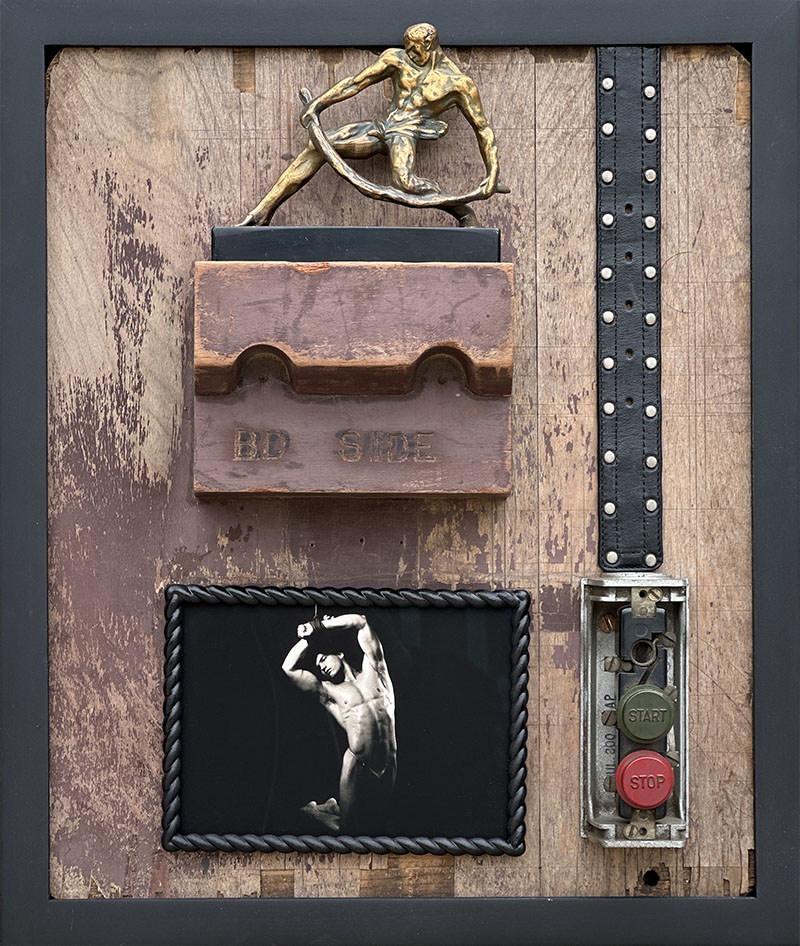
An Aesthetic of Obedience

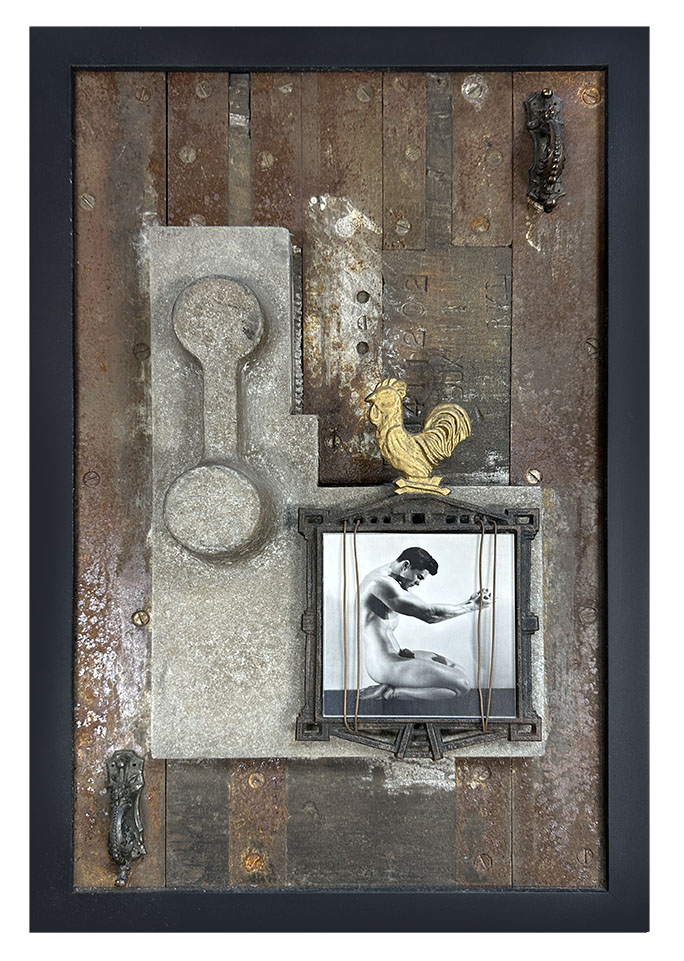
The photograph seen below depicts a scantily clad young man, hands tied, in a submissive position, illustrating an aspect of bondage and discipline (BD) play. A muscular, older male figure is seen on top, signifying a dominant role. This artwork delves into the complex psychological layers associated with bondage, focusing on obedience, and the essential elements of respect, trust, intimacy, and consensual power in these relationships. The concept of obedience in this context extends beyond physical restrictions to encompass mental and emotional submission. The artwork encourages viewers to look past the explicit physical elements of bondage and discipline play and to consider the underlying emotional terrain, involving communication, consent, and ultimately, the manifestation of identity and desire.

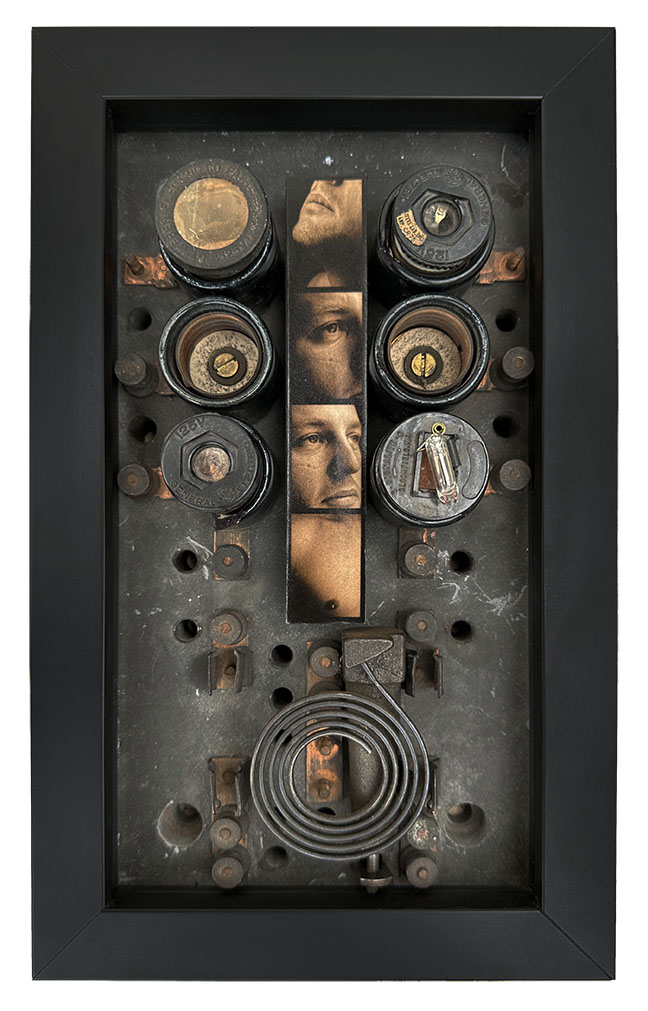
Juxtaposed Journey: Power and Vulnerability

This artwork provides a commentary on society’s views of masculinity, utilizing a fuse panel as a metaphor for strength and dominance. This is contrasted against the innate softness and susceptibility of human skin. Society often expects men to exhibit strength and resilience under pressure, without showing signs of fatigue or burnout. Yet, it’s important to acknowledge that fragility is an intrinsic aspect of all humans, irrespective of their gender. The title of this piece implies a journey towards achieving equilibrium between the capacity to transform oneself and the inherent vulnerability needed to embrace one’s authentic self.

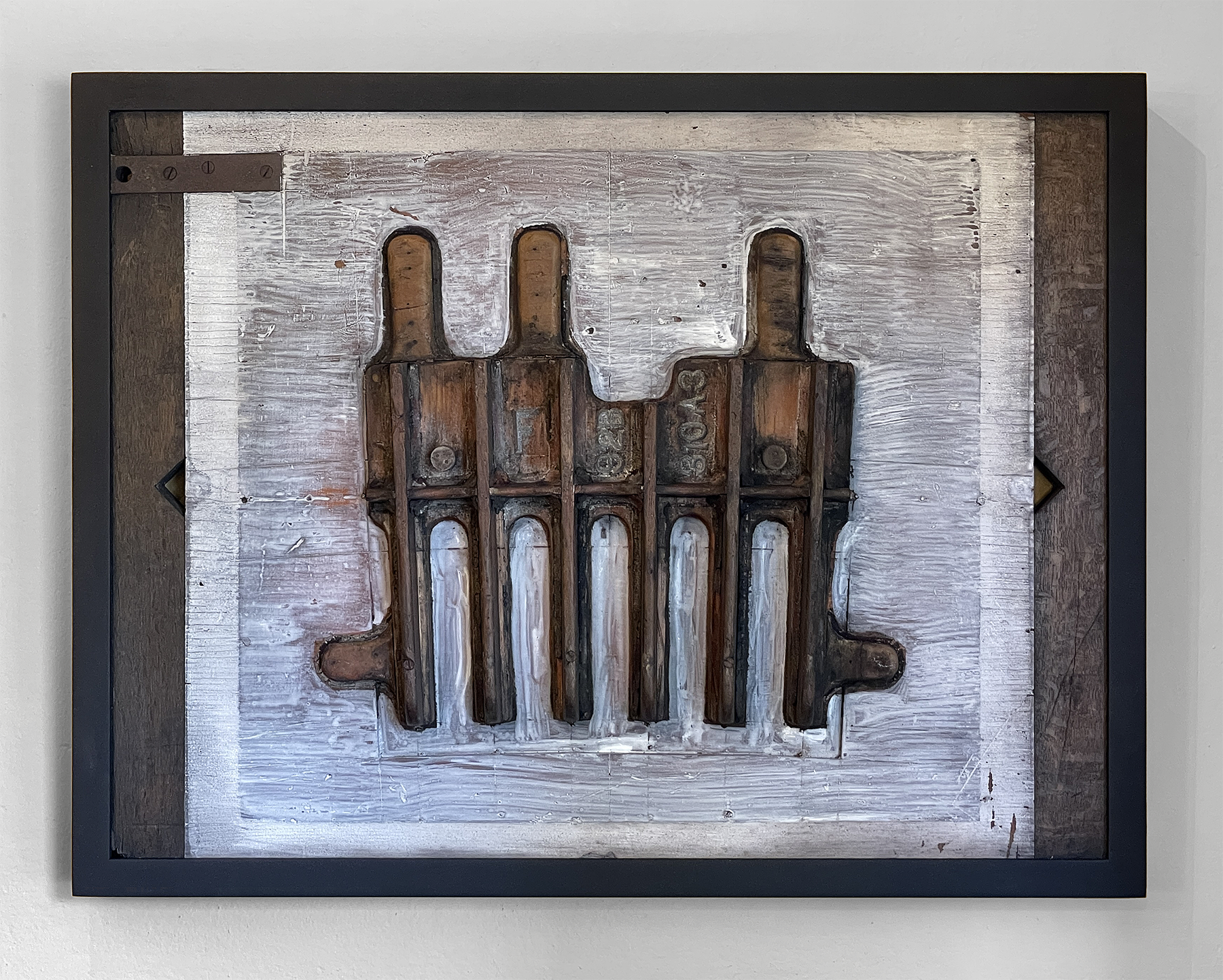
Ode To Thelonious Monk

Thelonious Monk (1917 – 1982) was a prominent Black-American pianist and composer who played a crucial role in the development of modern jazz. His compositions are characterized by intricate and dissonant harmonies, as well as unconventional intervals and rhythms.

This artwork pays homage Thelonious Monk’s groundbreaking contributions to jazz and his distinctive compositional style. The abstract fragment of a foundry mold reflects Monks’s innovative spirit and his defiance of traditional boundaries. The metal strap is a metaphor for the connections forged when artists share their work, while the white background symbolizes the blank canvas that innovative creators like Monk etch their lasting impressions upon. D’Elia often has jazz playing in his studio for inspiration.

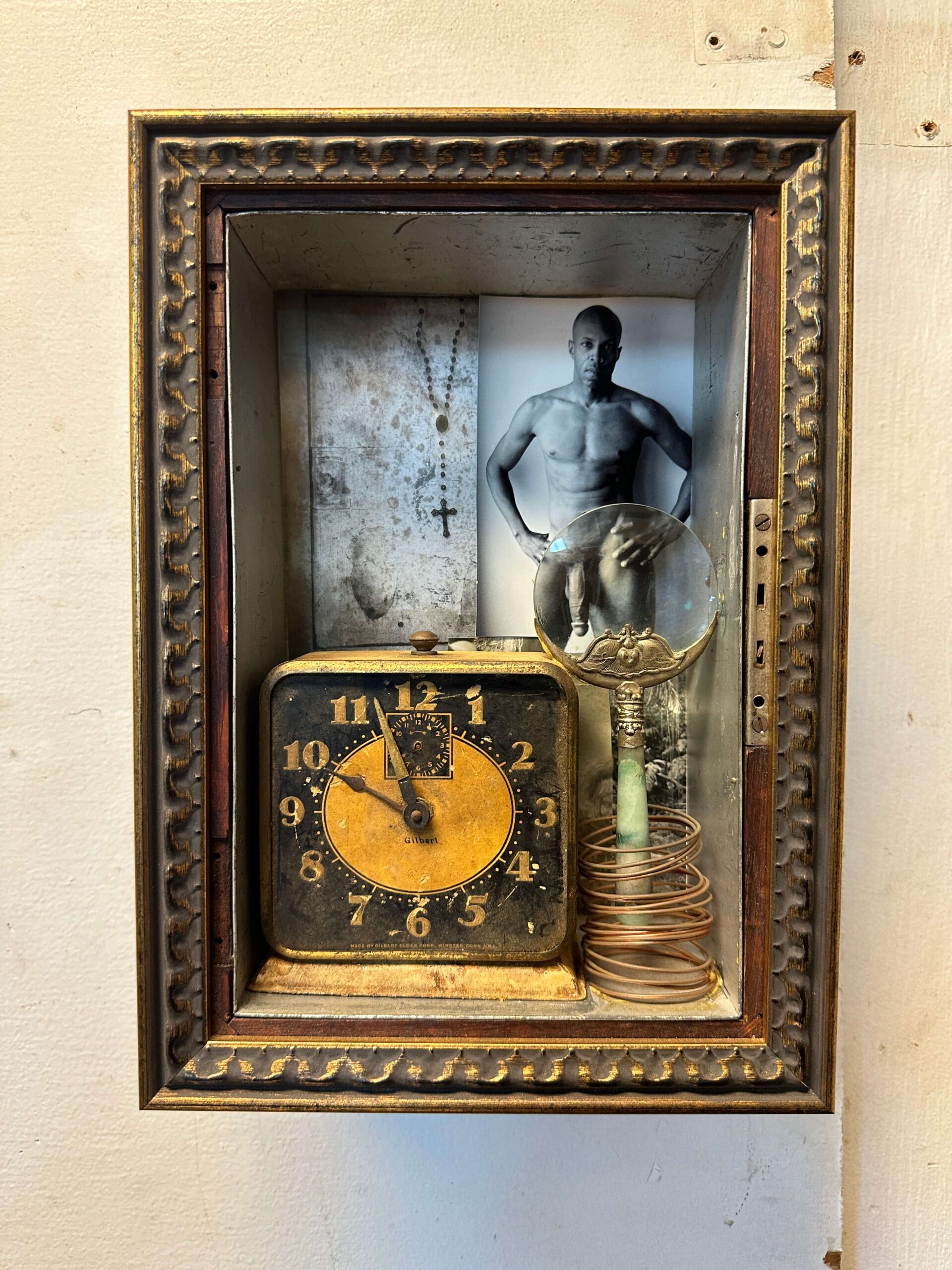
Big Black Clock (It’s Almost 10)

Big Black Clock (It’s Almost 10), blends humor, desire, and layered histories into a tightly framed reliquary. A weathered Gilbert alarm clock, frozen just before ten, anchors the composition while a mid-century male physique photograph and suspended rosary spark tension between the sacred and the erotic. A magnifying glass amplifies a specific part of the body, inviting both intimacy and awareness.

The title toys with the ear as much as the eye: depending on the viewer’s focus, “Big Black Clock” can be misheard as something far more provocative. Through this playful auditory pun, D’Elia disarms the viewer, encouraging curiosity while underscoring deeper themes of masculinity, coded desire, and the shifting passage of time.