Pass or Play (A Contemplation on Temptation)

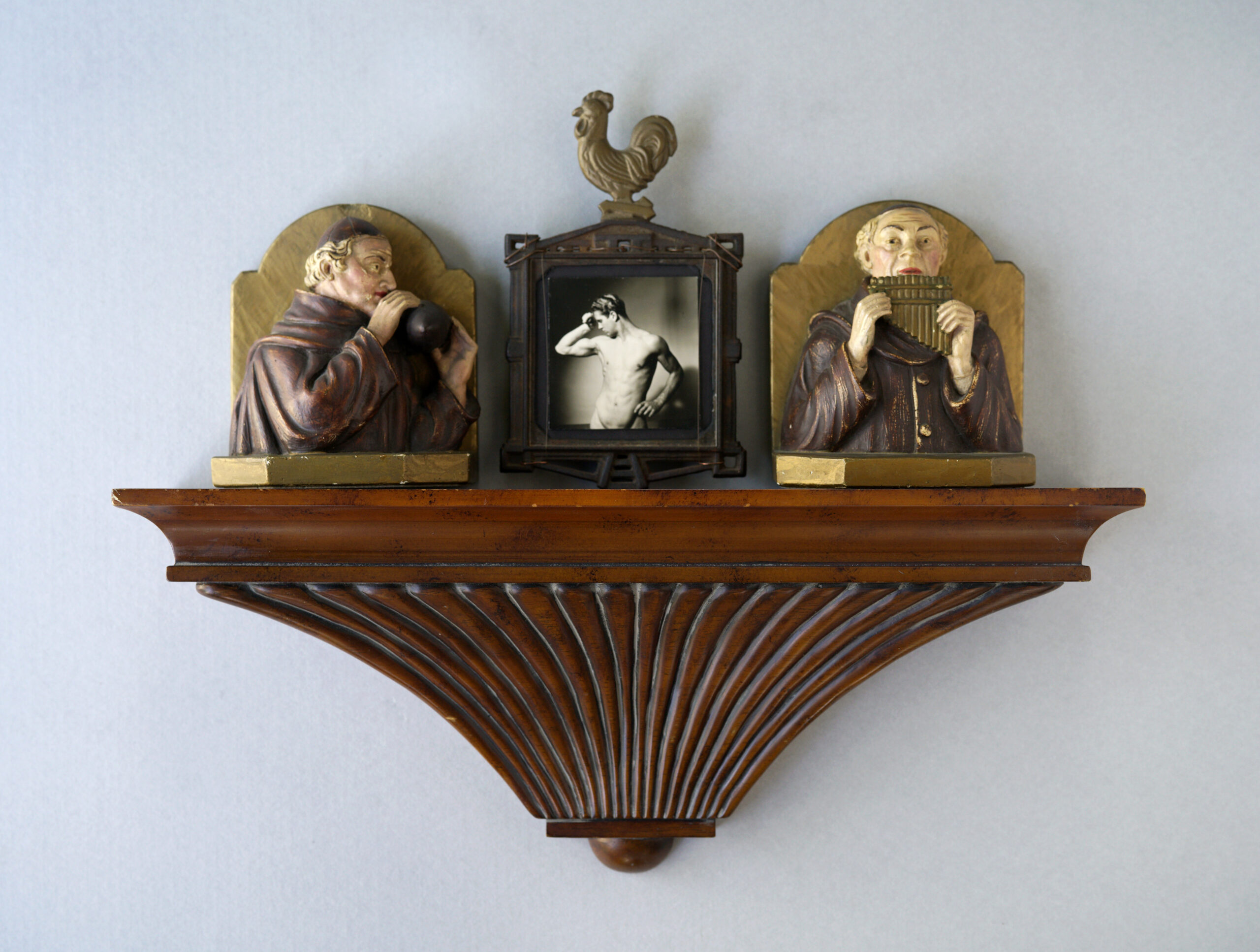
This artwork deals with desire, sexuality and temptation. As a visual pun regarding the title of this artwork, here we see two Jesuit priests, one holding a football and the other playing the flute. Whether to ‘pass’ on the temptation or “play” is the dilemma here. We see a very handsome young man as the source of temptation.

The photograph is a circa 1950’s vintage physique study, taken by Bruce Bellas (a.k.a. “Bruce of Los Angeles”). This now seemingly tame photograph was then considered to be pornography. The photograph is mounted on a trivet. A trivet is an object that holds hot plates slightly above a tabletop to prevent the heat from warping/damaging the tabletop. As we see here the trivet it is still holding a “hot plate” namely the image of the handsome young man. The artist used a trivet that had a rooster atop so that it could be painted gold as a visual pun in reference to “the golden cock.”

Double Whammy (Black & Gay)

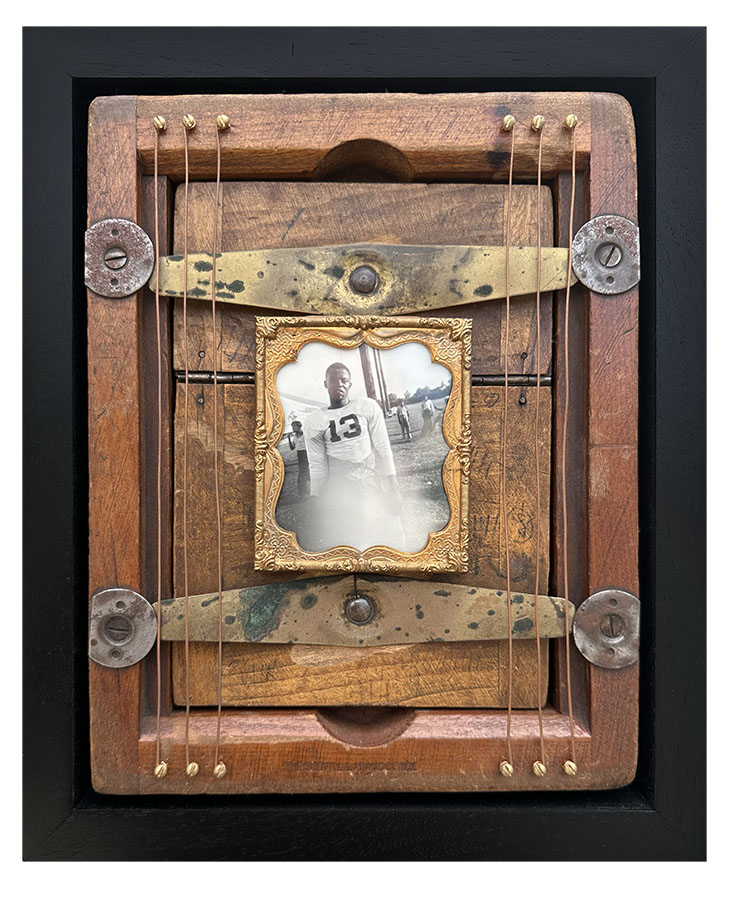
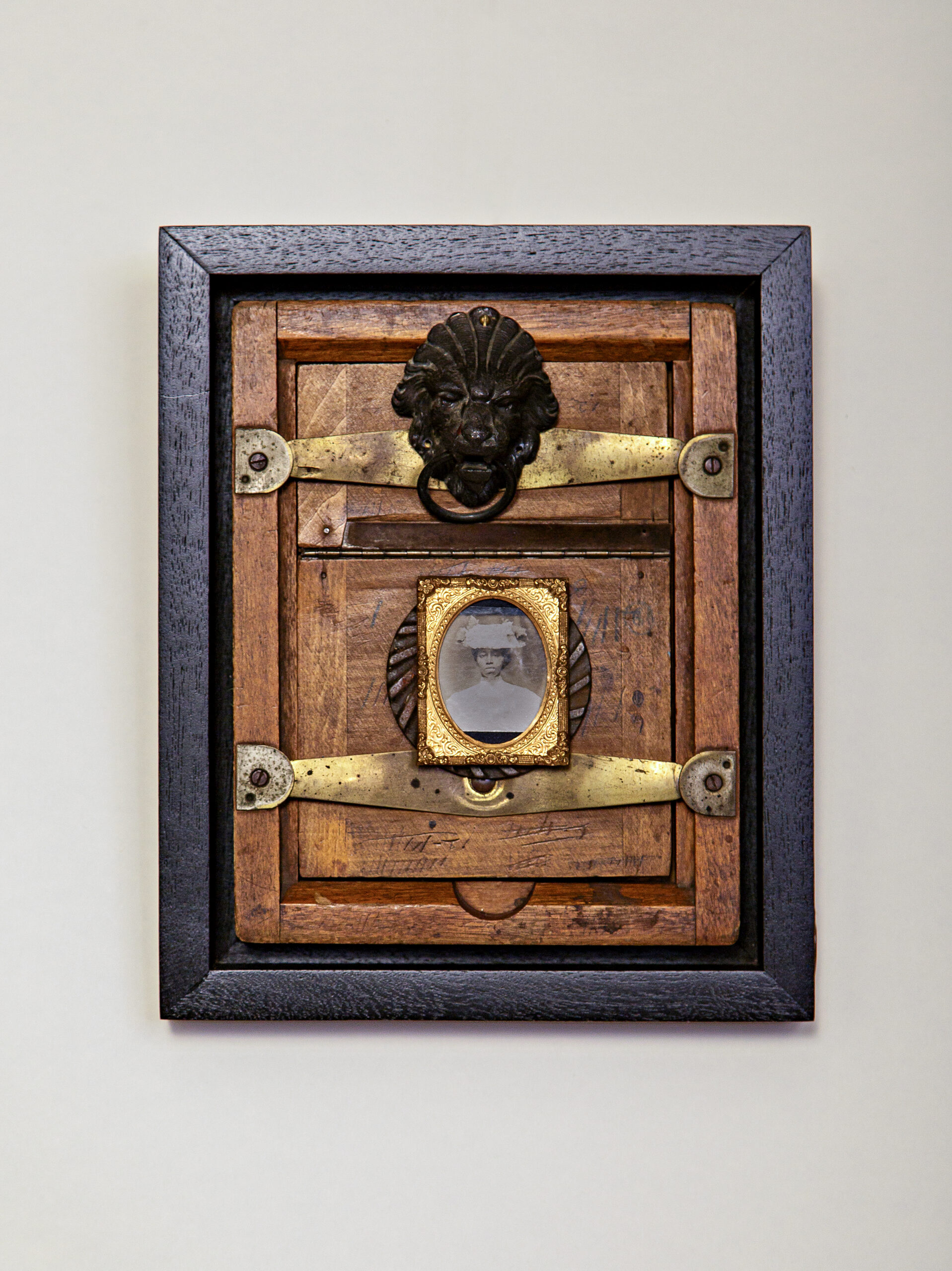
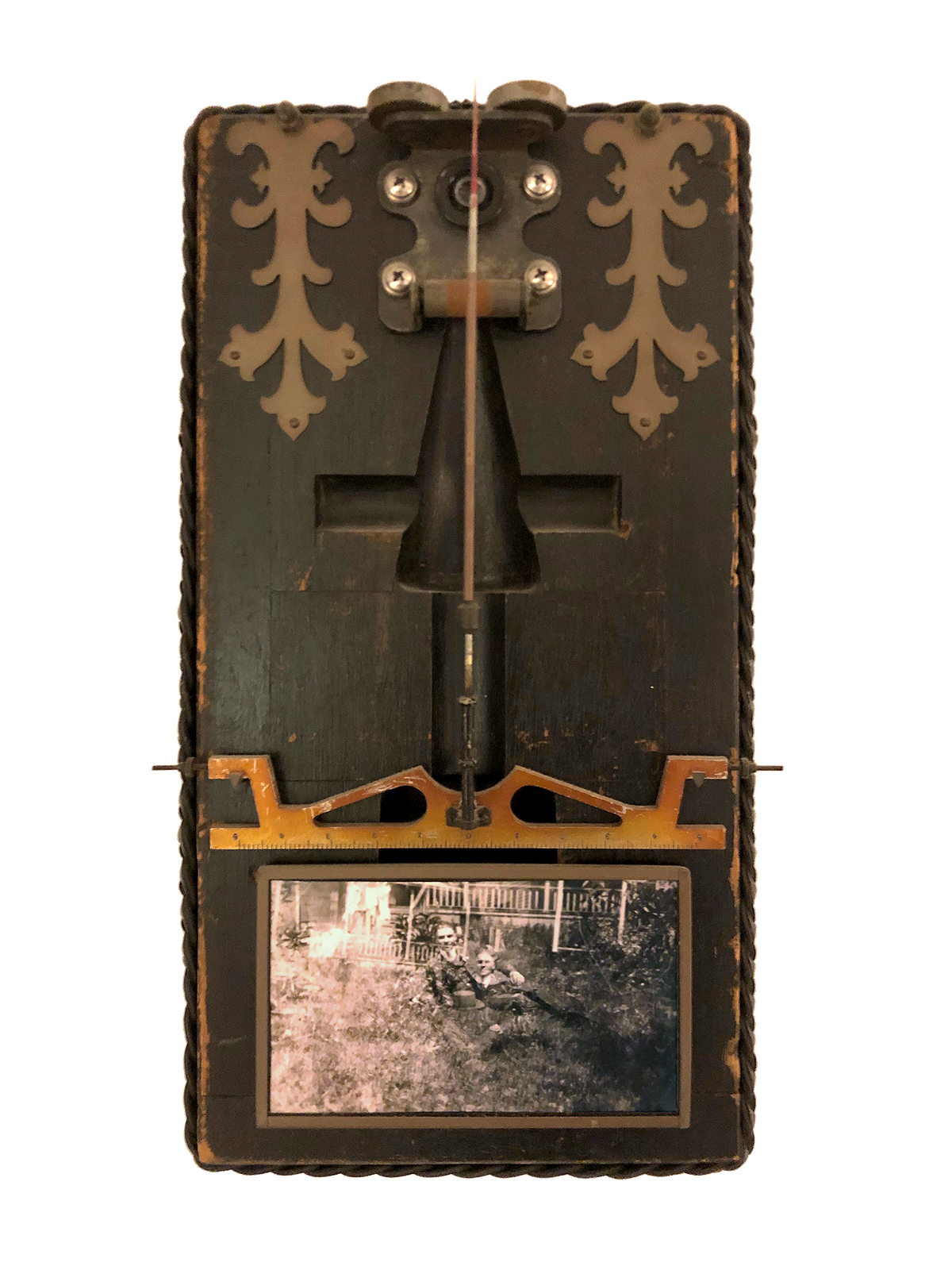
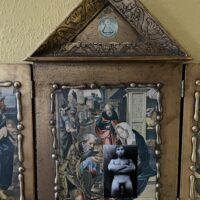
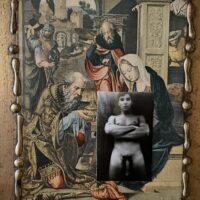
An antique contact printing frame serves as the base of this artwork. It was designed to transfer an image from a photographic negative onto photosensitive paper through pressure and light. Here it becomes a metaphor for the way identity is transferred onto a marginalized person by external forces.

The young man looks directly outward, composed and self-possessed. His jersey number, 13, carries the cultural freight of superstition and bad luck, and the title names the compounded weight of that freight: to be Black and gay in mid-century America was to carry not one but two designations that a fearful society coded as unlucky, unnatural, unwelcome.

The vertical copper wires are metaphors for prison bars. Racism builds a kind of prison for minority groups out of polite refusal and inherited assumption, out of neighborhoods with invisible borders and locker rooms where certain silences are understood. The young man looks out at us, steady and unbowed, and in that refusal to lower his eyes lives the quiet defiance of every soul who was told that the metaphorical prison cell, the ghettoization, the exclusion from opportunities and full participation in mainstream society was for his own protection.

The Victorian frame holding the photograph suggests the long historical lineage of that exclusion, its roots older than the photograph itself, while the copper wire holds everything in tension, beautiful and taut, stretched between fixed points with no slack to give.

That this piece was completed in 2026 is not incidental. The vintage photograph and Victorian hardware remind us that these structures of exclusion are old, but the assemblage speaks in the present tense because the machinery of racism has never been dismantled. In our current moment, racism persists not as some residual stain slowly fading in the wash of progress but as a force actively renewed, amplified now by far-right political movements that cloak white nationalism in the language of restoration, as though making America great were somehow separable from making America white again. The metaphorical prison bars have been polished and given new names, rebranded as policy, as border control, as tradition, as law, but the young man knows better. He knew in 1950. He would recognize this still.

John Doe

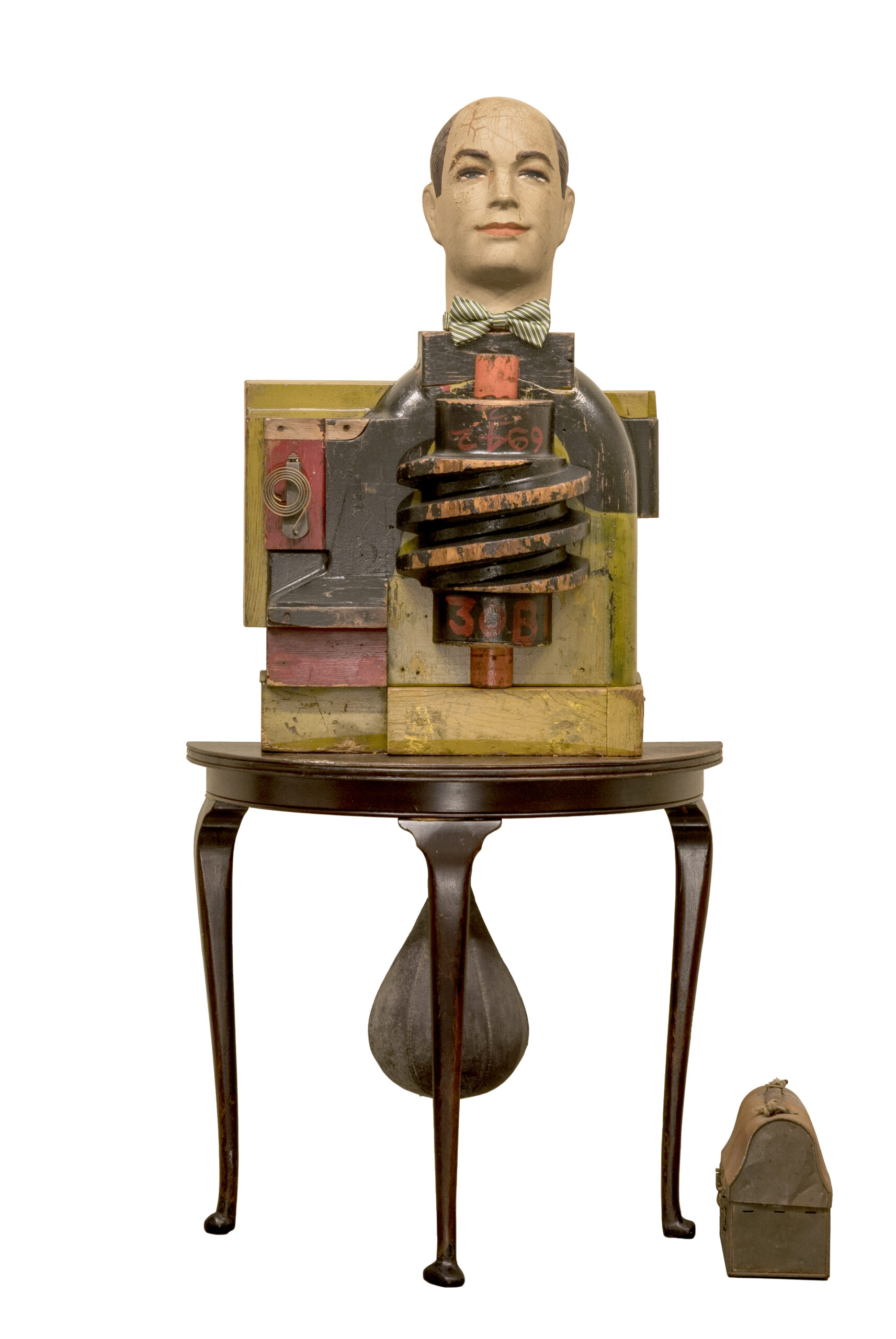
This artwork is called “JOHN DOE (homage to Ed Kienholz).” Famed beat era assemblage artist Ed Kienholz (1927 – 1994) created an artwork called JOHN DOE in 1959 reflecting his view of the “every man’s” condition in the 1950s.

Lou D’Elia created his JOHN DOE reflecting the current time period. D’Elia has been frustrated and concerned with the ongoing political dialogue surrounding proposed cuts to Medicare and Social Security, and the attempts at further “screwing” America’s ‘middle class.’ Basically the middle class have worked their entire lives with the promise that something would be there for them in their old age. Now it is uncertain whether the promises will be kept.

D’Elia’s JOHN DOE represents the typical blue collar American worker who basically starts off against the wall (hence the use of a three-legged table that is designed only for use against the wall). The fact that the American worker is being “screwed” is represented by the use of a large antique wood screw foundry mold for his chest/heart, and of course his balls are always being kicked (represented by the somewhat deflated Everlast speed bag hanging under the table. The ‘speed bag’ is used by boxers to sharpen their punching skills). On the backside of this artwork is an aluminum Social Security card that shows JOHN DOE’S Social Security number 000 – 00 – 0000 representing his likely fate. This artwork, as is true with all artworks by D’Elia, has a vintage numbered factory tool checkout tag attached to the artwork next to the artist’s signature.

D’Elia uses old foundry molds in his art because his father was a pattern-maker and made similar things out of wood for a living and so D’Elia grew up with them in his life. Sadly these handmade foundry molds are discarded objects now much like the American workers who have lost their jobs because their places of employment have closed and gone out of business or because they are older workers whose once valued skills have become obsolete due to advancing technology.

Aunt Emma’s Situation

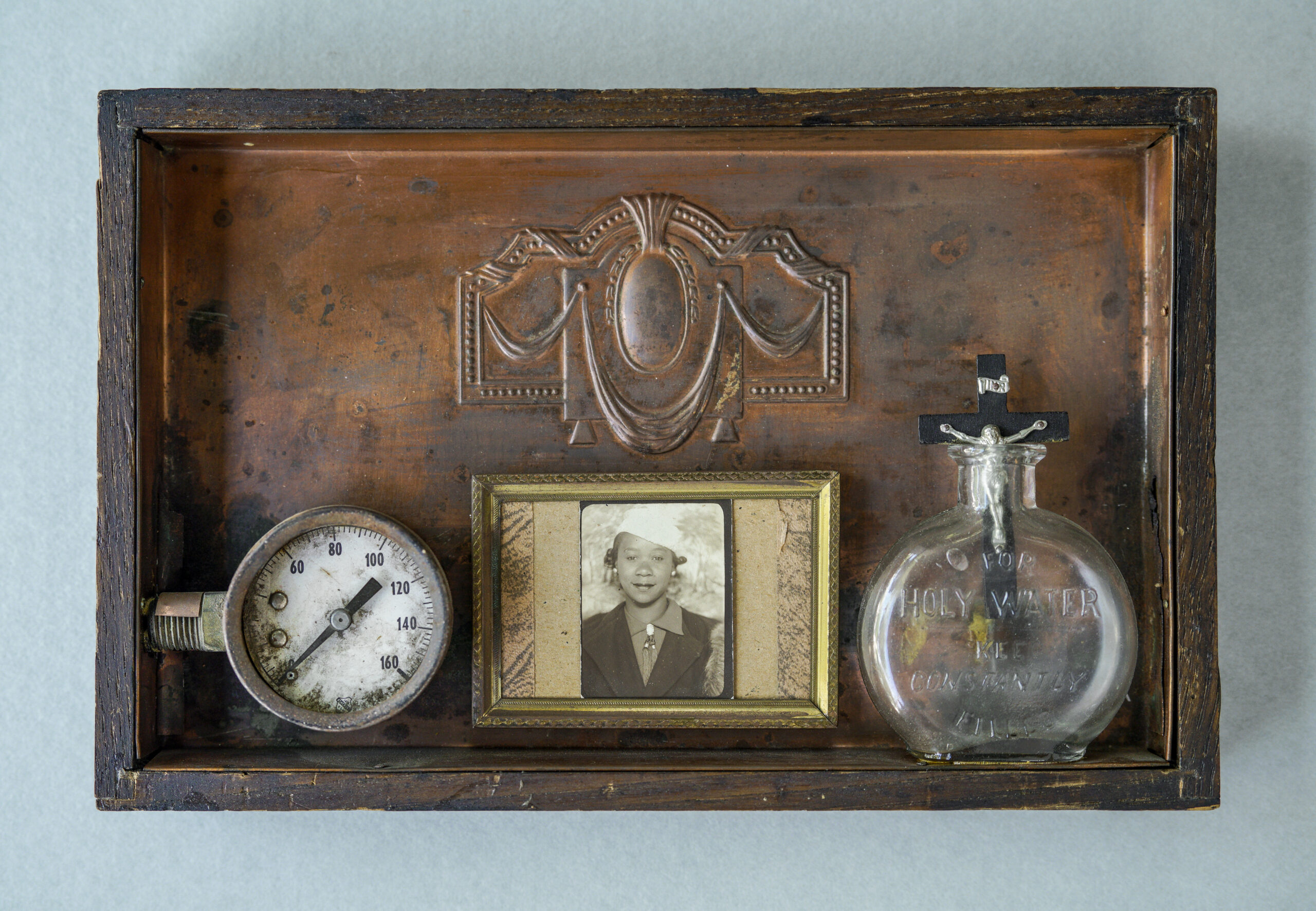
This piece comments on the struggles of African-Americans and the stress and pressure they constantly have to deal with as the result of racism in our culture. We see here the artist’s use of a pressure gauge and other visual references to ‘applied pressure’ such as the pressed tin lid to a humidor to represent that stress. We also see the artist’s use of a bottle of holy water and a Christian cross reflecting hope gained by strongly held religious faith.

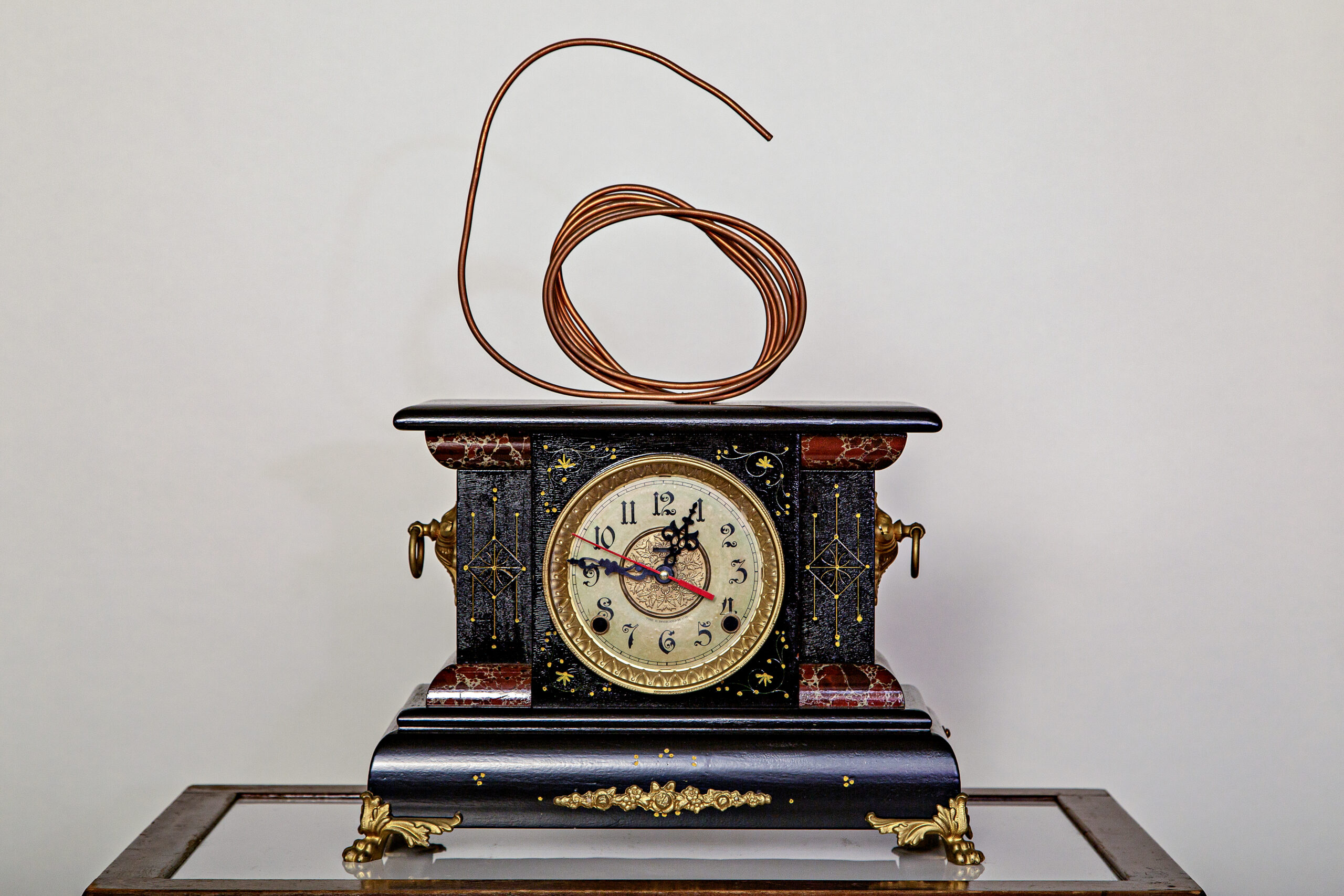
Clock Lobster

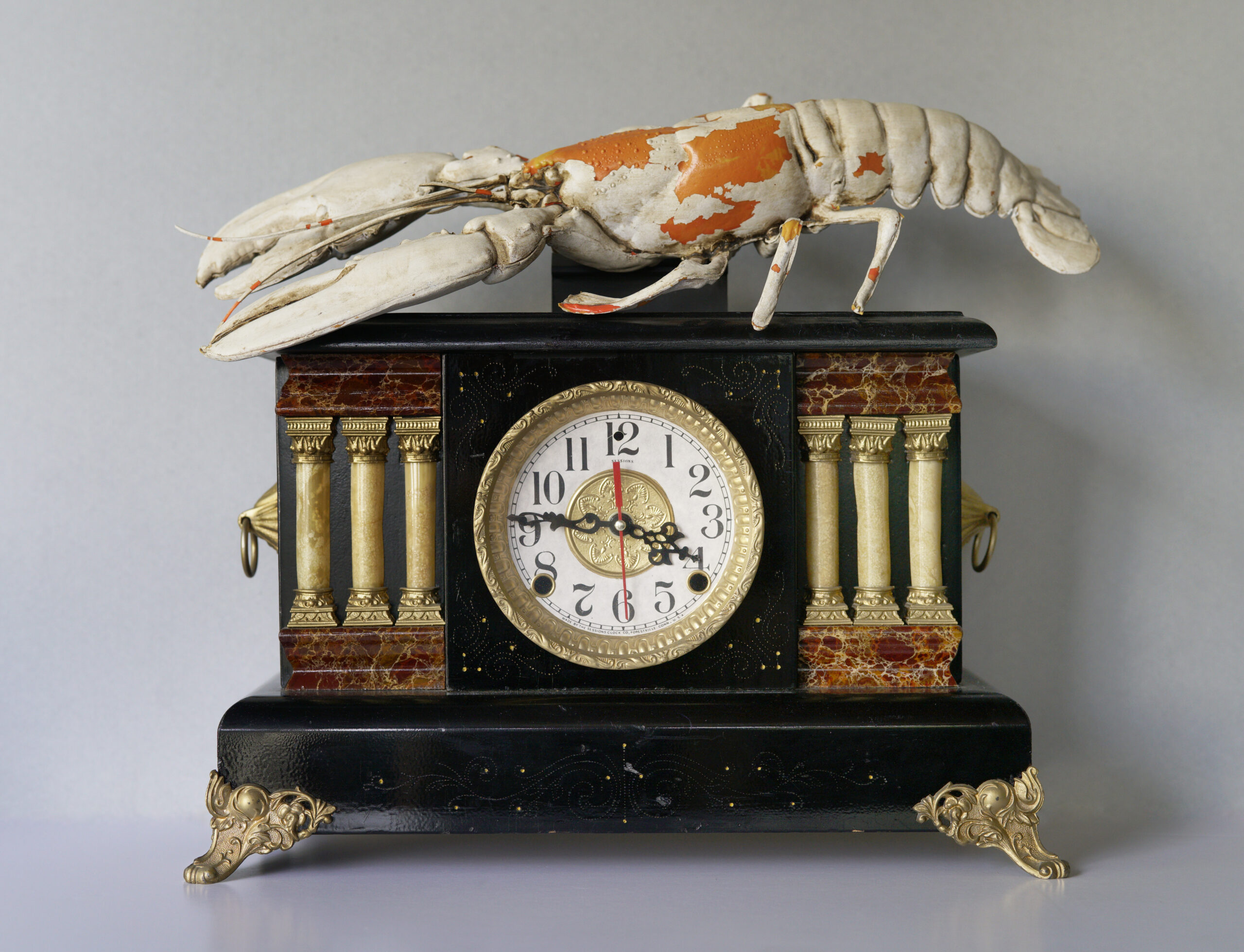
This artwork is an homage to surrealist artist Salvador Dali who made a lobster phone artwork in 1938. D’Elia here creates his ‘lobster clock’ that is a commentary on some of the seemingly surreal times that we all experience during the course of our life journey.

The Conversation or Lack Thereof

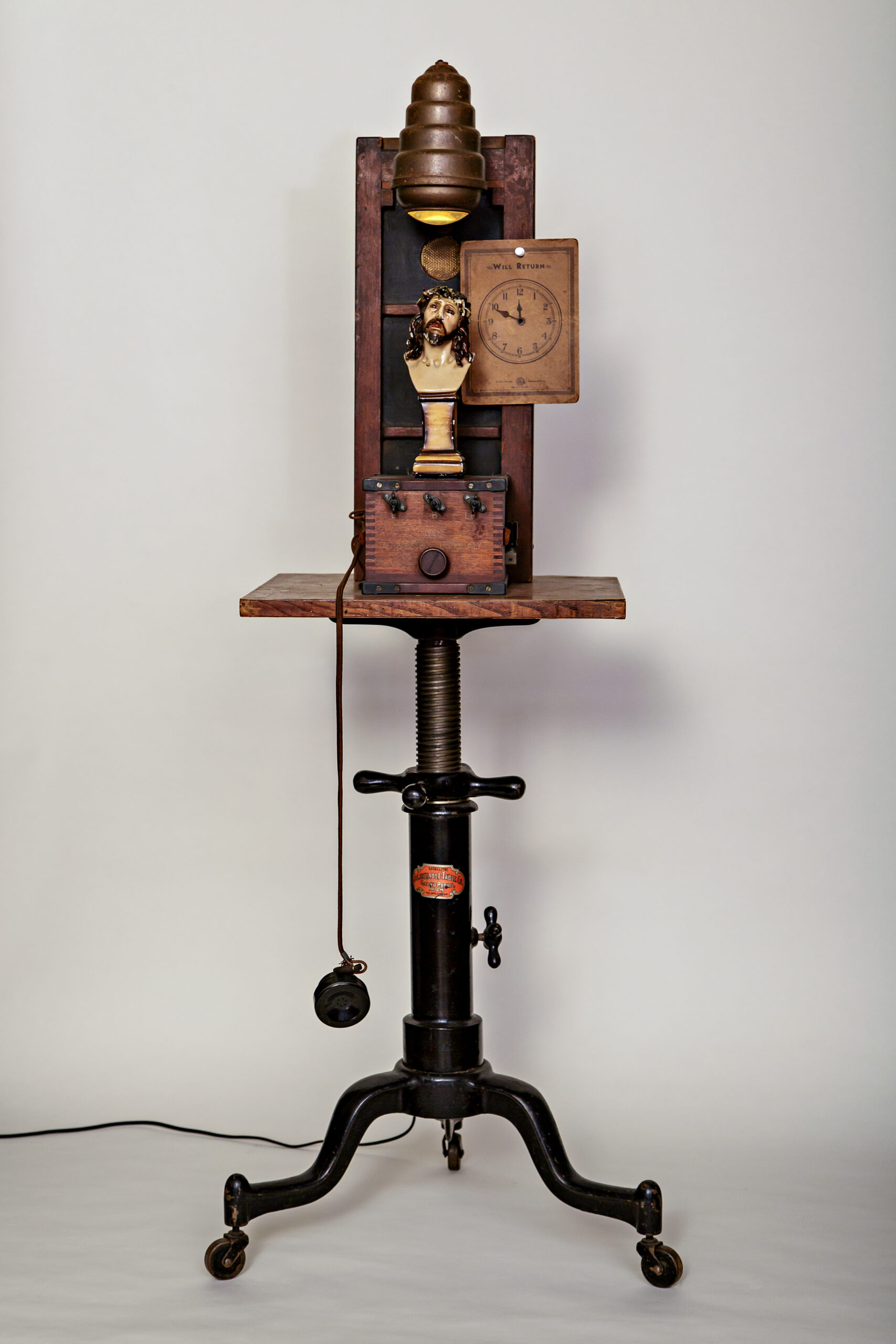
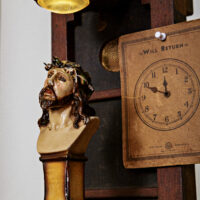
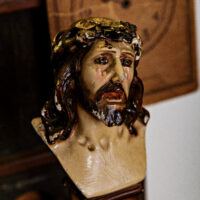
This piece is a commentary on taking responsibility, or not, for decisions and actions as the result of one’s free will. This artwork is ultimately a commentary on those who do evil things to others in the name of “God,” “Jesus,” “Allah” or other religious representations of “a higher power.” Here we see the bust of Jesus (somewhat aged and beat up) that sits atop a telephone lineman’s field test phone where the switch is set to “listen only.” Evidently the person who had been here, listening, did not like what they were hearing and so the listening device is left hanging as if the listener left in a hurry. Jesus is presented here as if he is being grilled/interrogated. The use of an Art Deco machinist’s “bullet lamp” above reinforces that effect. We also see in this piece reference to Jesus’s “Second Coming” promise with the use of a “Will Return” sign.

This artwork is part of D’Elia’s “Rolling Conundrum” series. The rolling conundrums are artworks created to represent problems that occur everywhere in the world. All world religions, all of which preach the power of love, have been abused by some and used as a bully platform to harm others. This artwork comments upon the questioning of one’s faith and beliefs and whether there exists a God or higher power.

Good Times Burn Fast

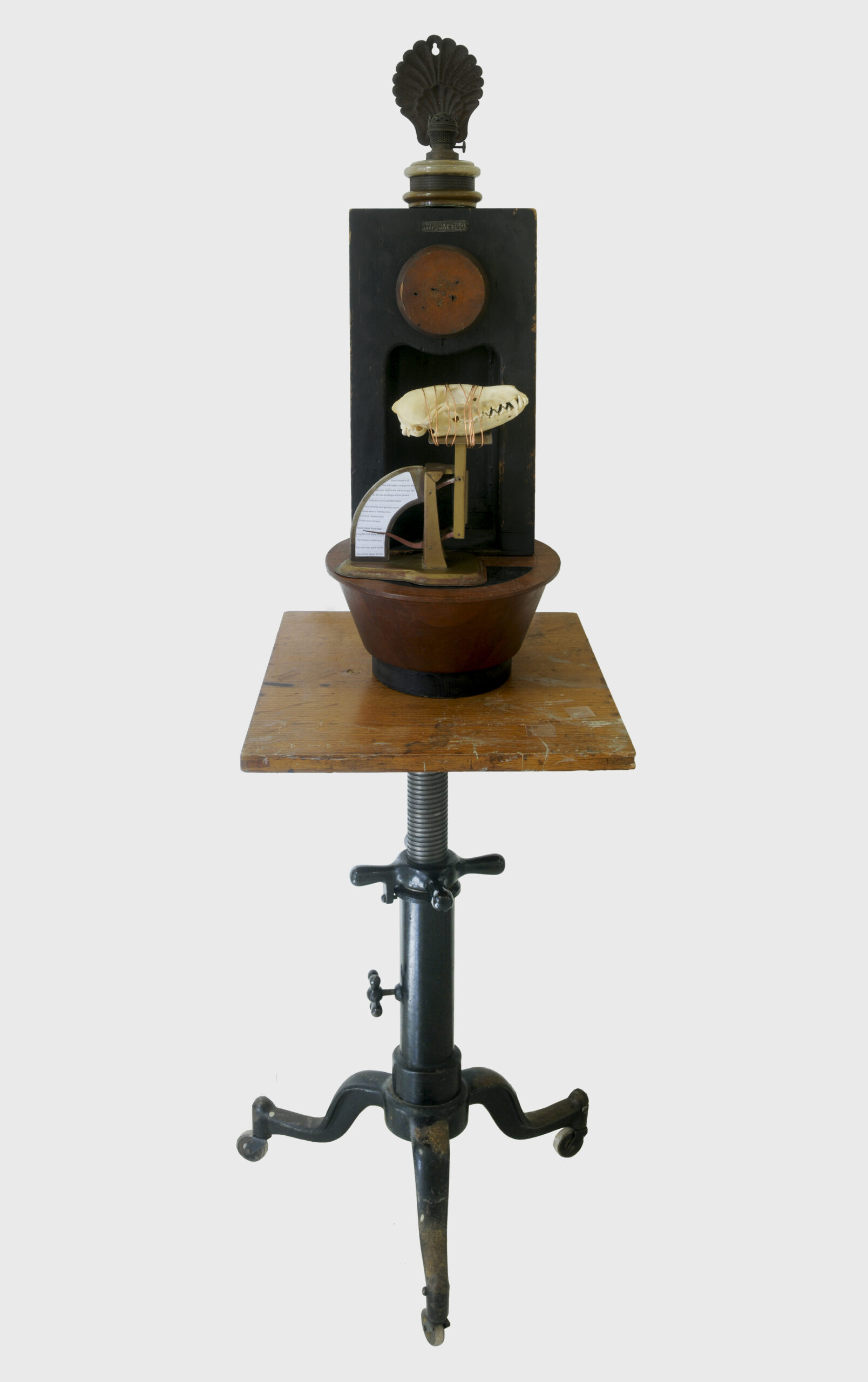
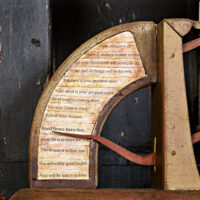
This artwork is a commentary on the fact that even if you are fortunate to live to be 100 years old (or older) life passes very quickly. The artist is commenting on the importance of living your life, actualizing who you are as the unique individual that you are, and adding that back into the world. As Pancho Barnes, famous aviatrix, was noted for saying, “Don’t try to be like anyone else because we’ve seen that already!” This artwork is made up of a whale oil lamp sitting atop fragments of wood foundry molds. We see a red fox skull wrapped in copper wire sitting atop a scale. The artist has affixed to the front of the scale numerous Chinese fortune cookie sayings that he collected over the course of two years.

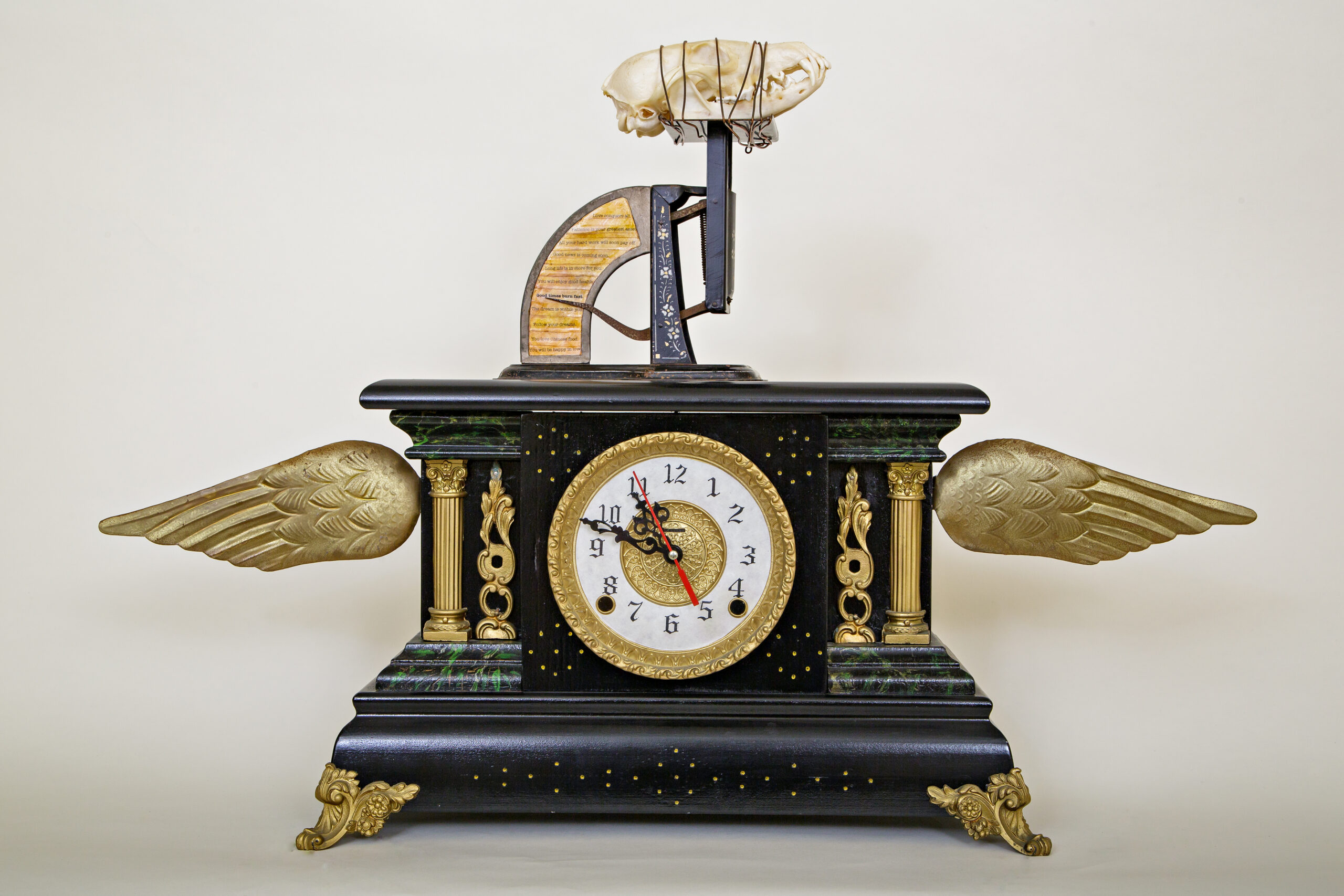
Be sure to read some of the fortune cookie sayings that are pasted to the front of the scale. The weight of the skull has the pointer on the scale pointing to the fortune cookie saying, ‘Good times burn fast.’

This is another artwork from D’Elia’s ‘Rolling Conundrum’ series. The rolling conundrums are artworks created to represent problems occurring everywhere affecting everyone.

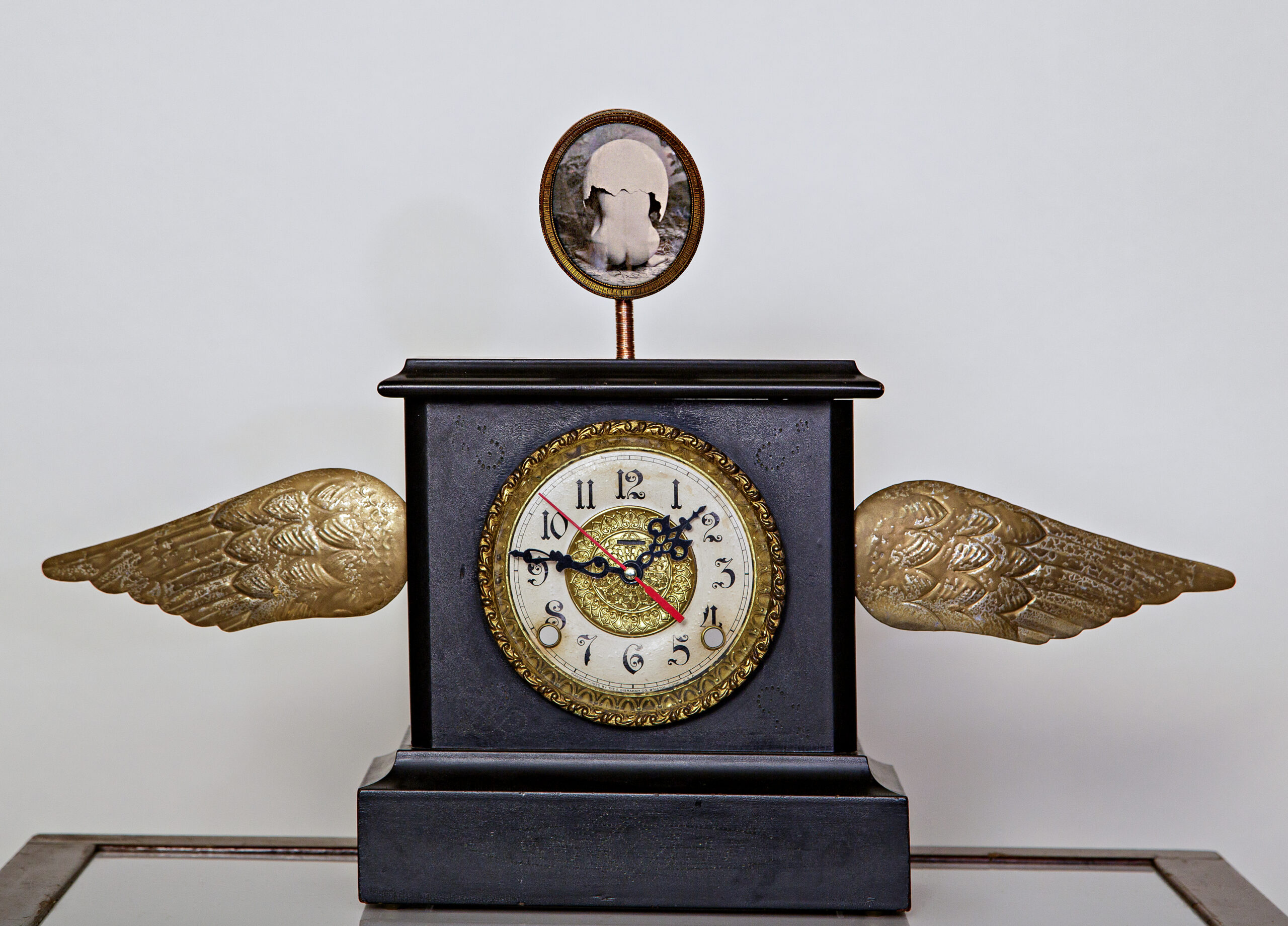
Good Times Burn Fast (Clock)

This artwork is a commentary on the fact that even if you are fortunate to live to be 100 years old (or older) life passes very quickly. The artist is commenting on the importance of living your life, actualizing who you are as the unique individual that you are, and adding that back into the world. As Pancho Barnes, famous aviatrix, was noted for saying, “Don’t try to be like anyone else because we’ve seen that already!” This artwork is made up of a century old mantel clock with attached tin wings painted gold, and an antique postage scale sitting on top that has a red fox skull wrapped in copper wire. The artist has affixed to the front of the scale numerous Chinese fortune cookie sayings that he collected over the course of two years. The weight of the skull has the pointer on the scale pointing to the fortune cookie saying, “Good times burn fast.”

Good Times Burn Fast

Cowboy Dreams

The artist grew up in 1950’s America, when country swing music was popular and cowboy characters were a familiar presence in movies and on TV. Often the cowboy was presented as the idealized male, the embodiment of masculinity, patriotism and goodness. They were ‘super heroes’ of 1950’s America.

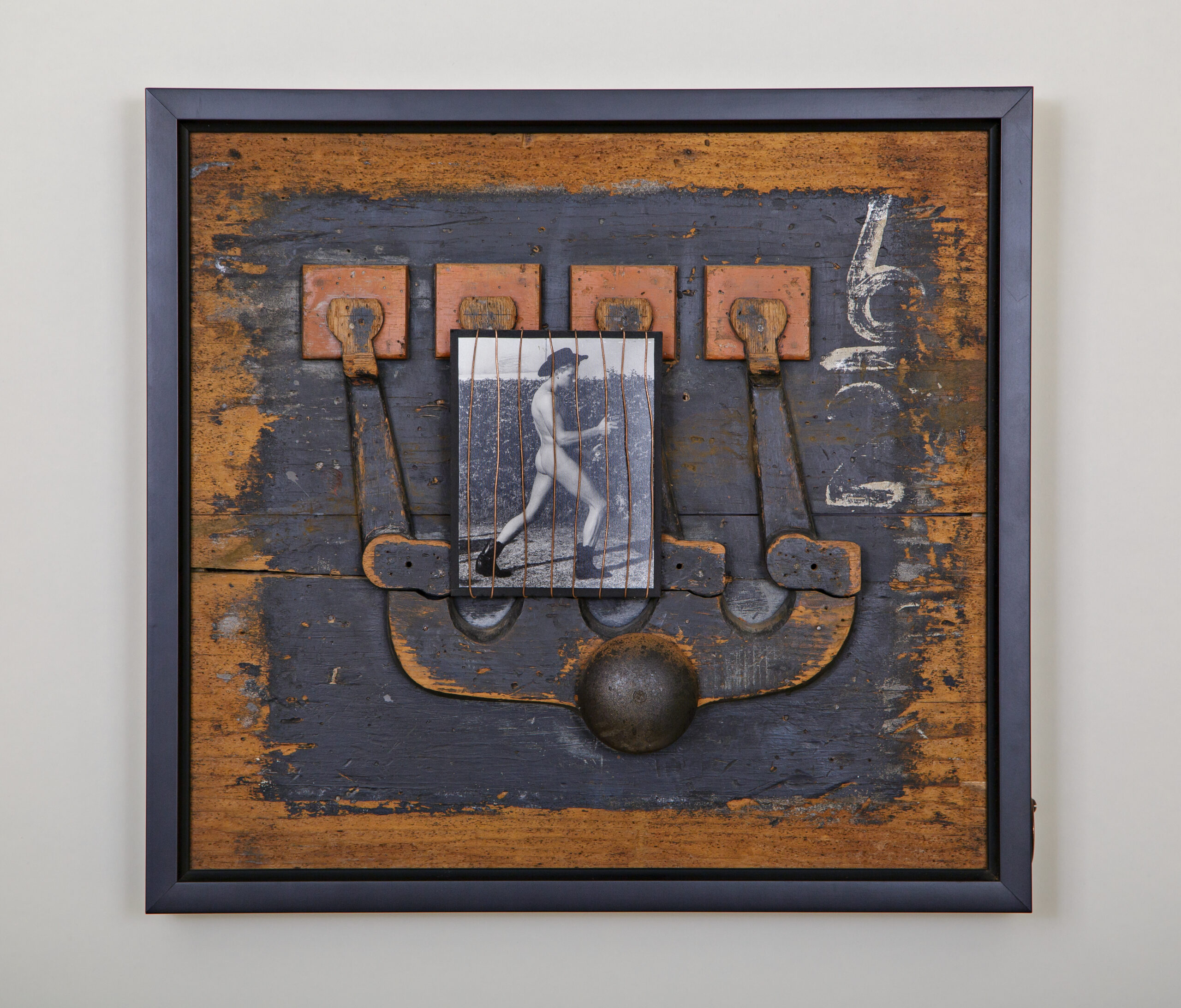
As a little boy, early heroes for D’Elia included the handsome TV cowboy star Roy Rogers of the Roy Rogers Show, Clayton Moore who played the Lone Ranger, and the older aviation cowboy, Kirby Grant, who played Sky King. As a little boy D’Elia had fantasies about hanging out with them and going on adventures together. With this artwork, D’Elia celebrates the fantasy of the American cowboy. However, the use of the copper wire represents the ‘quiet prison of despair’ that D’Elia felt back then with the realization that he would likely not be accepted by the cowboys if it was discovered that he was a gay boy.

Good Time With Jimmy

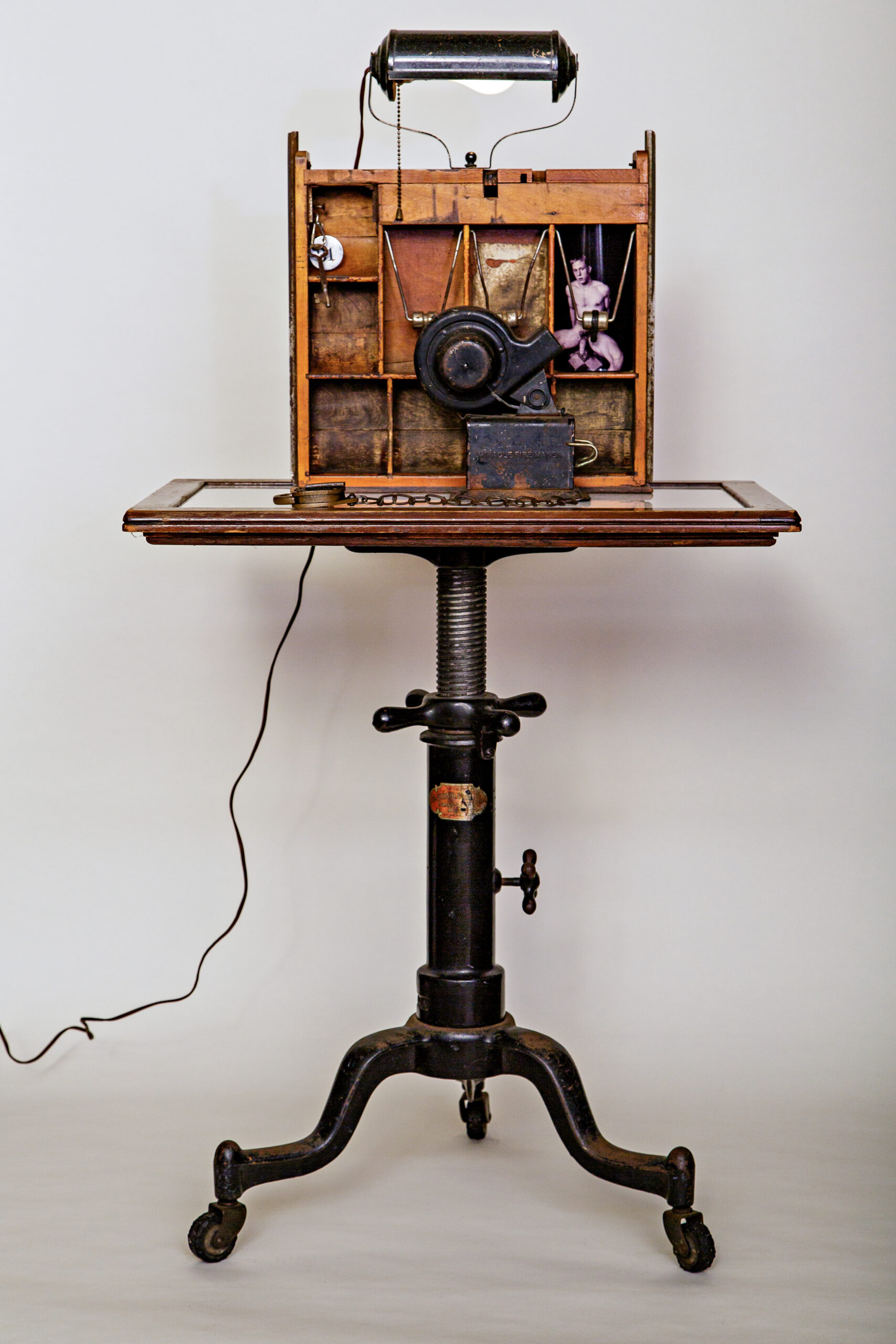
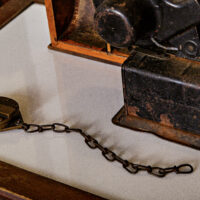
This artwork is about prostitution…specifically male prostitution. Here we see a wood cash register drawer tilted up on end with a light fixture with red light bulb atop. We see a photo of Jimmy in the large denomination cash compartment at right. At left we see a skeleton key to his hotel room: number 31. In front of the cash drawer sits a blower, used to make a fire burn hotter (and a reference to Jimmy’s special skill). Lying flat on the cold medicinal white surface of the tabletop we see a padlock and chain (manufactured by the Climax Lock Company), arranged in the shape of a sperm.

One of the most pervasive fears faced by LGBTQ youth is being disowned and abandoned by their family and being thrown out of their home. Every year thousands of LGBTQ youths are disowned and rejected by their families, forcing them into homelessness because of their sexual orientation. Of the young homeless seen on the streets it is estimated that up to 40% identify as LGBTQ. Further, once thrown out of the home, LGBTQ youth face an even more hostile environment because they are discriminated against in shelters, in foster care and on the streets. Sadly, many LGBTQ homeless youths turn to drugs and alcohol, and/or selling their bodies, trying to find some escape from the crush of emotional pain from the harsh reality of rejection and abandonment.

This is another artwork from D’Elia’s “Rolling Conundrum” series. The Rolling Conundrums are artworks created to represent problems found everywhere in the world.

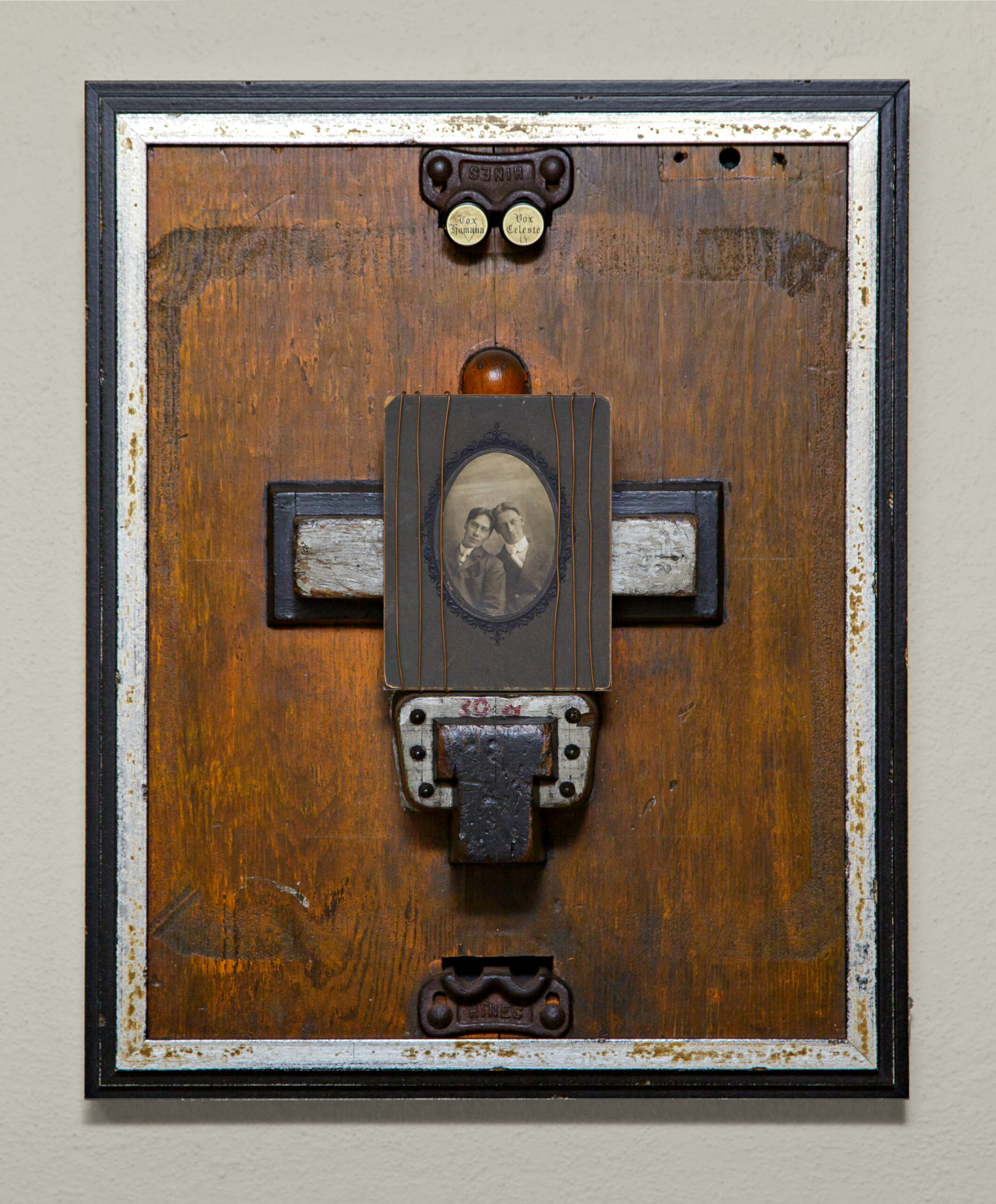
Vox Humana. Vox Celeste.

Here we see a male couple from the late 1870s early 1880s. This photograph may be the only evidence remaining of their relationship as a couple. The couple is presented with copper wire stretched across the front of the photograph, suggesting punishment by isolation from mainstream society. It must have been very difficult to have a same-gender relationship back in the 19th Century, even more so considering theirs was a race discordant relationship.

On top we see two pump organ voicing knobs (aka: organ pullers) reading Vox Humana. Vox Celeste. This artwork is called Vox Humana. Vox Celeste translating to “Human Voices. Heavenly Voices.” The artwork reflects their life path: they were once human voices and now they are heavenly voices. The entire artwork was constructed to suggest the form of a cross.

Daddy’s Boy

It is not unusual to see relationships where one of the partners is significantly older than the other. In heterosexual couplings it is fairly common to see an older man dating a much younger woman. This is also true within the gay men’s community, and there are dating apps such as SilverDaddies and DaddyHunt to assist with making a connection.

Here we see a 24 year old “Daddy’s Boy,” with the metal numbers atop suggesting that his partner is 56 years old. The use of a mantle clock gong is a reference to time. The phallic shaped coil suggests that the ‘boy’ is uncircumcised. As the backdrop we see an old hand-made foundry mold that had been previously discarded.

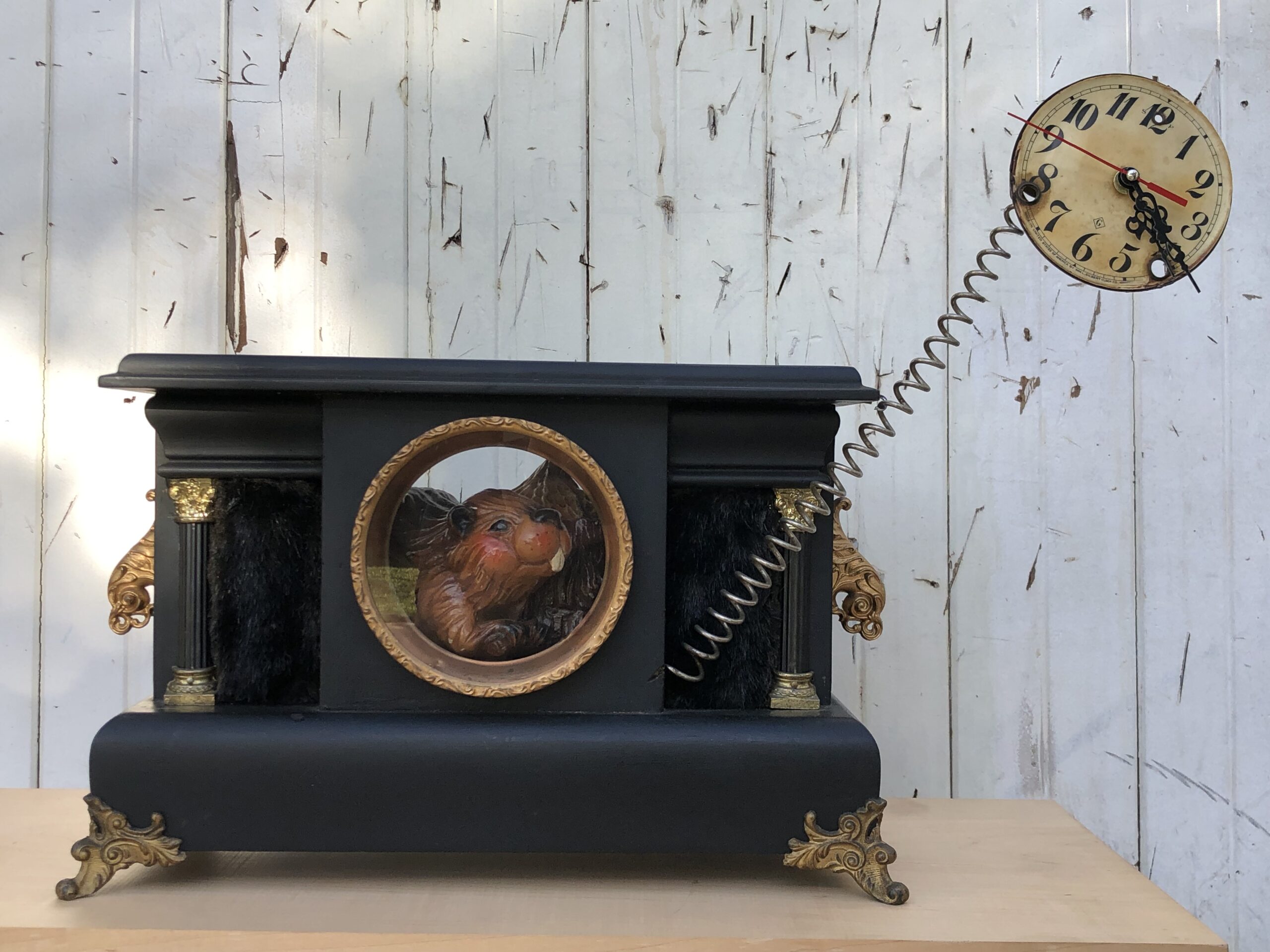
It’s Beaver Time!

This clock was made as a housewarming gift for artist-designer Gino Perez. Gino, who is straight, is one of the artist’s closest friends. D’Elia has noticed through their years of friendship that Gino is rarely “on time” for anything. As such, the clock timepiece is seen exploded out of the clock. In it’s place is a chalkware beaver bookend acknowledging that regardless of the time of day, sex is almost always on a man’s mind.

Collection of Gino Perez

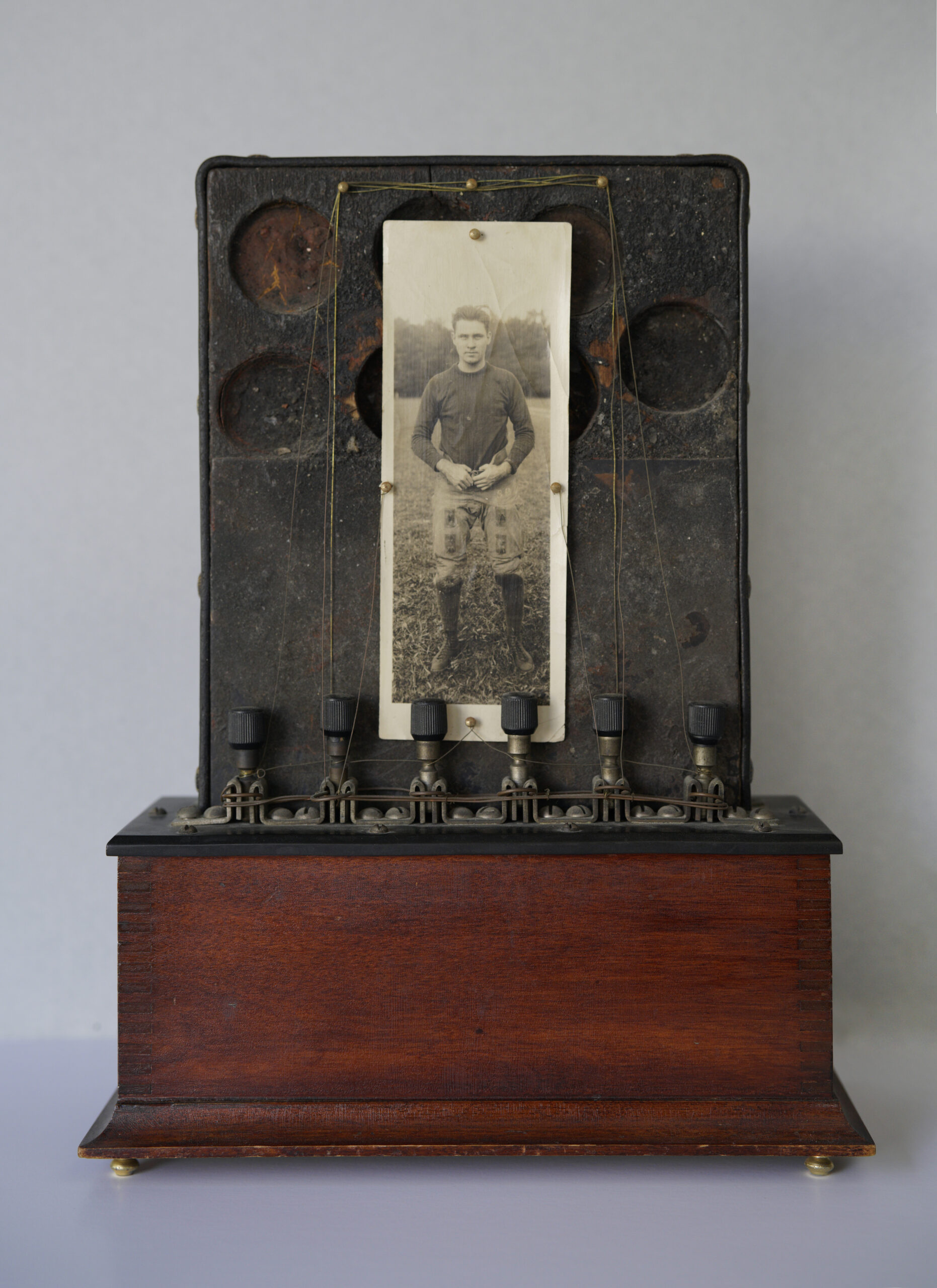
Lineman

This artwork is a contemplation on masculinity. We see at the center a photograph depicting a determined, strong masculine young man wearing a gridiron football uniform circa 1910. He is a lineman. The artwork is constructed from an early 20th century electrical resistor box that forms the base, with a wood found object sitting on top that has survived a fire. The use of copper wire and a leather belt fragment complete the assemblage; all parts commenting on the strength and energy of masculinity.

Mount Olympus!

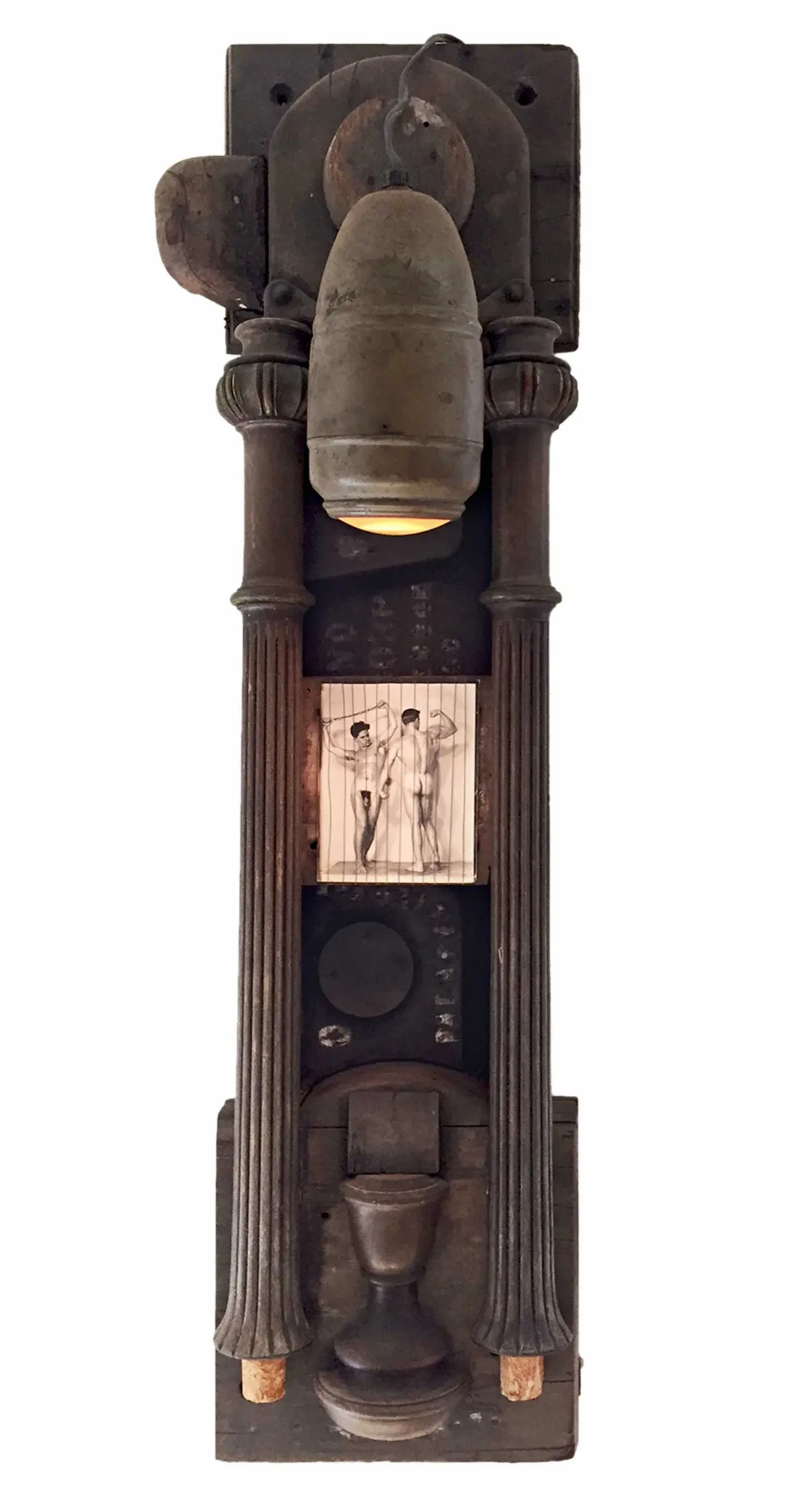
This artwork was designed to suggest a Greek temple. The artwork is composed of remnants from an antique foundry mold and the shaft pieces from an antique floor lamp. Atop is affixed a machinist’s bullet lamp that is used for illumination.

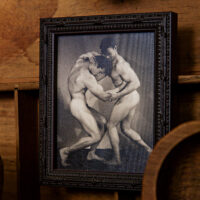
In the photograph we see presented idealized masculine beauty in the ancient Greek tradition. The photograph has been wrapped in copper wire to suggest that the men depicted are imprisoned and/or otherwise removed from mainstream society.

Greece was the birth place of the Olympic games, so it is no surprise that in ancient Greece cultural capital was placed on athleticism. The beauty of a fit, muscular masculine body occupied a central role in Greek culture and aesthetics.

The athletes of ancient Greece typically exercised in the nude in gymnasiums, where they would also socialize and practice sports in the nude. Men were encouraged to maintain their manly bodies. Indeed, any sign of flabbiness was seen as undesirable. The later remains true today in our culture, leading to problems with body dysmorphia and body shaming. A physically fit male is desired in both heterosexual and homosexual relationships.

The two men depicted here are flexing their muscles and showing their bodies to their sexiest effect. The question arises: Are they posing for an observer or are they posing for each other? The title of this artwork is a pun on the title’s command, and it is left to the viewer to decide which one is Olympus.

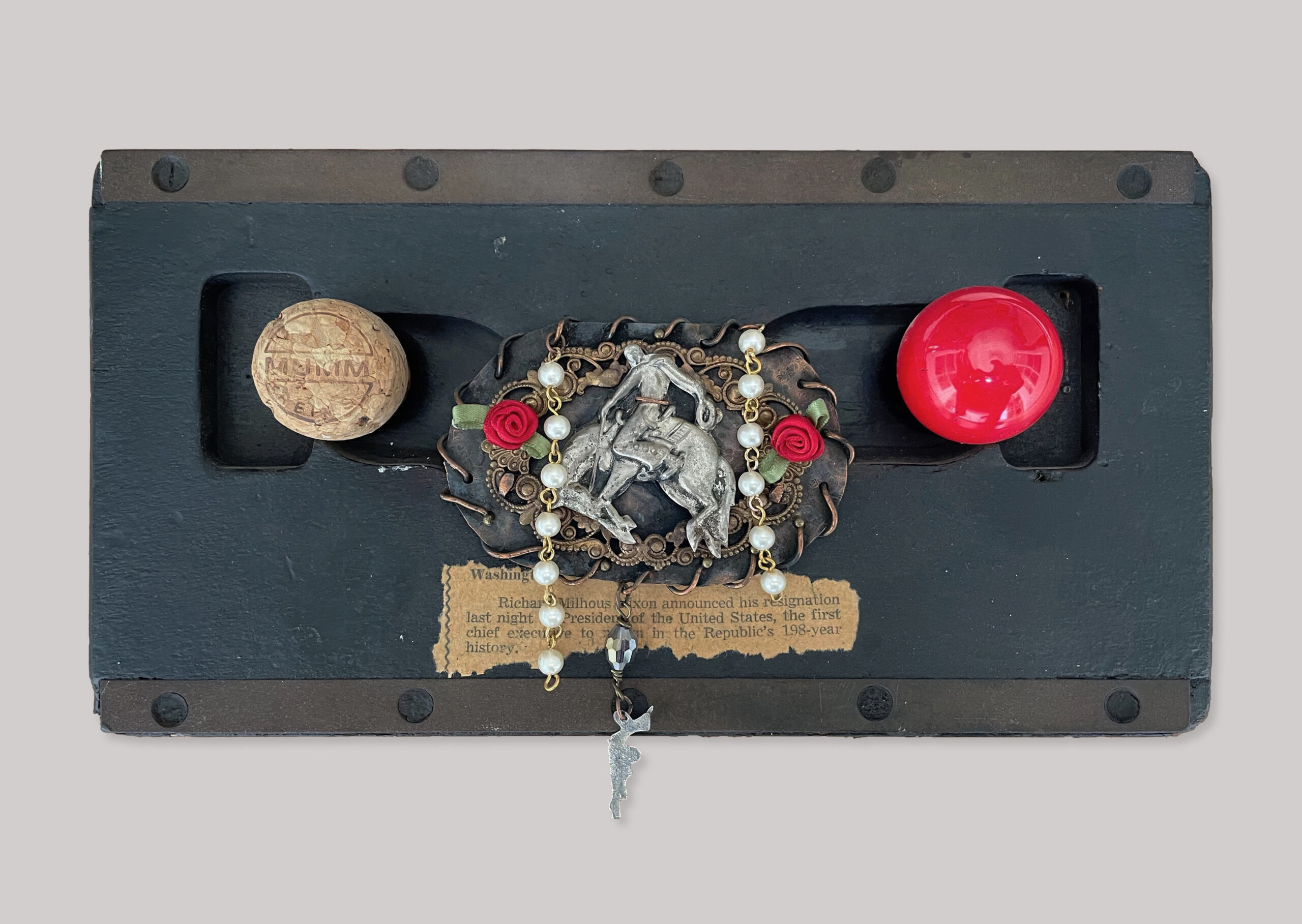
President Dick

Richard M Nixon, a Republican, was the 37th president of the United States and accomplished many good things for the country and world during his presidency. He enjoyed the pomp, ceremony and power of his office and presented an almost regal persona. Unfortunately, his power went to his head. He kept a White House enemies list and actively sought to undermine the power of his perceived political enemies. Ultimately, he was forced to resign following the Watergate scandal. That scandal involved his abuse of power in trying to unearth ‘dirt’ on his political adversaries, trying to keep the Watergate break-in a secret, and denying that he had anything to do with it.

Richard Nixon’s best friend was a sharp dressing, charming Cuban-American banker named Bebe Rebozo. Rebozo lived alone for much of his life in a well-decorated Key Biscayne home (Nixon eventually moved next door). Rebozo, who once worked as a flight attendant, enjoyed show tunes, and was a frequent guest at the White House and Camp David. They spent much time alone together. Of course, there were rumors that they were more than friends.

Collection of Gino Perez

Ring for Service

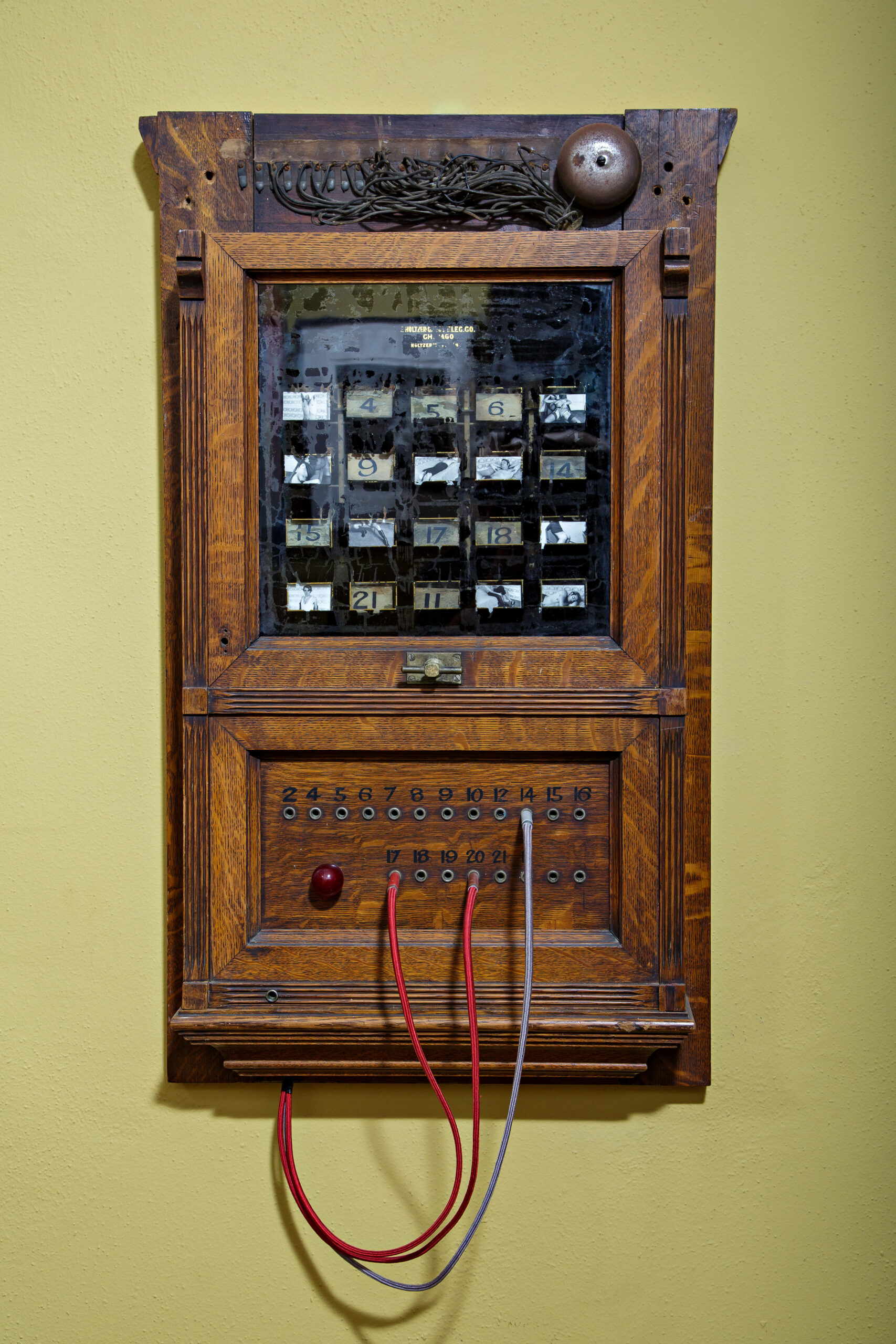
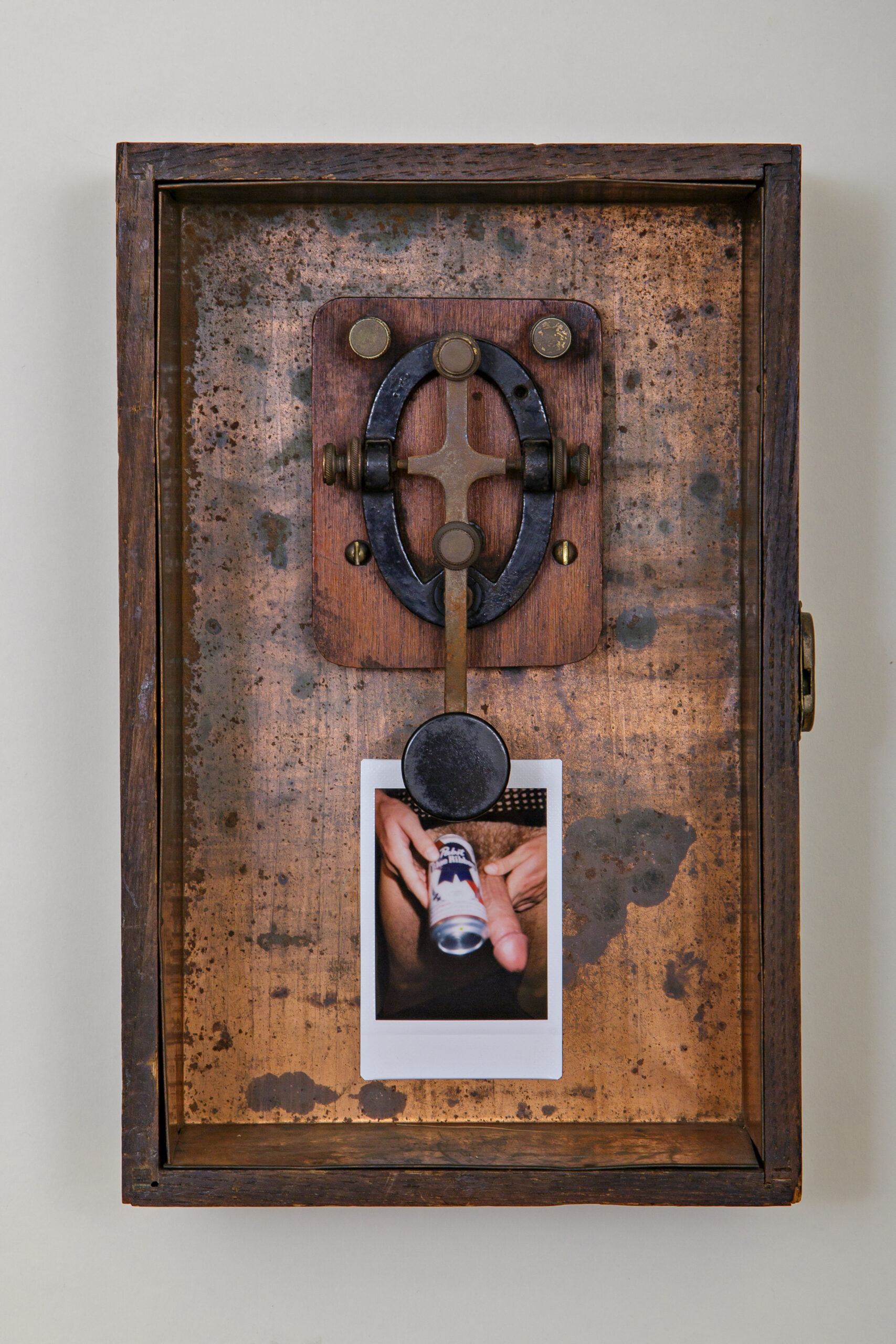
Prostitution has been called the world’s oldest profession…and there is a reason why it is still thriving. This artwork is a commentary on prostitution, sexuality, sexual desire, fetishism and the human need for feeling loved and/or feeling cared for (even if in a fantasy situation).

Here we see a circa 1920s hotel room annunciator. An annunciator is an announcement device that was found behind the front desk of better hotels in the late 19th and early 20th century. When a hotel guest wanted room service (such as more towels, a change of bed linens, some water, etc), they would flip a switch in their room that would activate the “annunciator” downstairs, flipping their room number up on the annunciator panel so that the front desk would know to send a staff person to that room to take care of the request. With D’Elia’s annunciator we get to see what actually goes on in most hotel rooms around the world. We see photographic depictions representing sexual fantasies and desires….male and female.

Together Forever

Here we see two older men, a gay couple, presumably together for many years. Their relationship is remembered now only as traces of light on gelatin silver photographic paper. The double exposure appears to document a happy home life and also suggests that they remained together even after their lifetime ended.

This photo was removed from an unknown ‘photo album’ and put up for sale on eBay. Perhaps the album was initially purchased at a yard sale because there were no living heirs to inherit the ‘family photo album’ and was later disassembled for sale by an enterprising eBay seller. The more likely scenario was that a surviving heir was so removed in time from their ancestors shown here that the photo album lacked personal meaning for them, and/or they decided to remove from the family album any documentation of a same-gender relationship that had existed in their family. In any event, the monetary value of the photo became more important than any sentimental value that may have existed.

The artwork is framed using a men’s leather belt. The photograph is affixed to a remnant of an industrial foundry mold. D’Elia uses old foundry molds in his art because his father was a pattern-maker and made similar things out of wood for a living and so D’Elia grew up with them in his life. These handmade foundry molds are discarded objects, sadly much like the photograph seen here. We also see the use of remnants from an antique weight scale, suggesting the difficult balance that gay men often face in deciding when and how to reveal to family and friends their true self and love relationships.

This artwork is from an ongoing series by the artist featuring vintage double exposure photography as a commentary on the quick passage of time and the importance of celebrating and embracing relationships during one’s life.

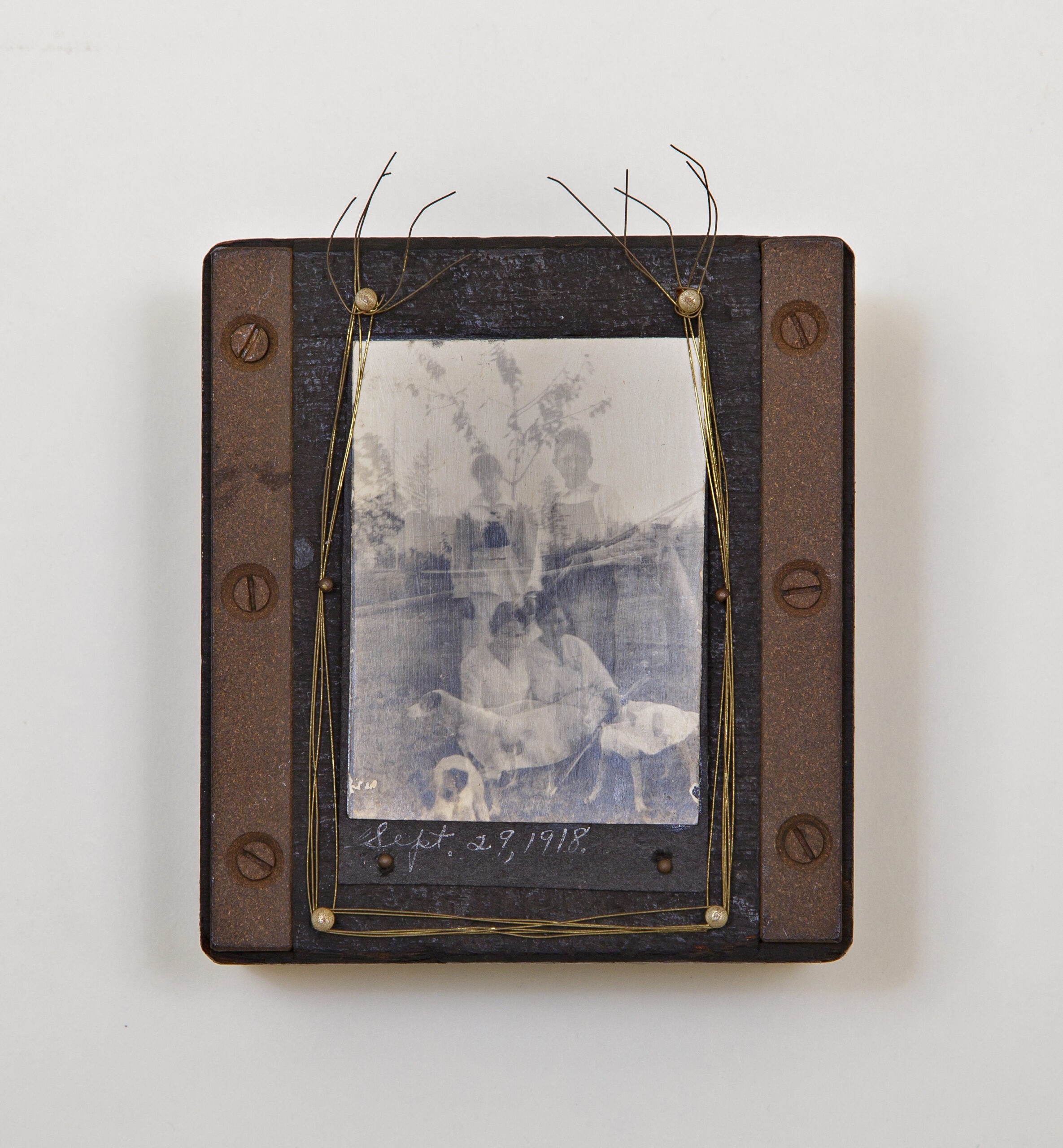
September 29, 1918

Here we see lives that no longer exist. Only their images live on as traces of light on gelatin silver photographic paper, captured in a moment in time, specifically September 29, 1918. This photo was removed from an unknown ‘family photo album’ and put up for sale on eBay. Perhaps the album was initially purchased at a yard sale because there were no living heirs to inherit the ‘family album’ and was later disassembled for sale by an enterprising eBay seller. The more likely scenario was that a surviving heir was so removed in time from their ancestors shown here that the photo album lacked personal meaning for them. In any event, the monetary value of the album and the photos therein became more important than any sentimental value that may have existed.

The photograph is affixed to a remnant of an industrial foundry mold. D’Elia uses old foundry molds in his art because his father was a pattern-maker and made similar things out of wood for a living and so D’Elia grew up with them in his life. These handmade foundry molds are discarded objects, now sadly much like the family photograph seen here. We also see copper wires on either side of the photograph. Copper wire which is frequently used as a conductor of energy is used here to suggest faded bouquets of flowers, with their blooms and their life-force energy long gone.

This artwork is from an ongoing series by the artist featuring vintage double exposure photography as a commentary on the quick passage of time and the importance of embracing family and friendship connections during one’s life. In otherwords, be grateful and cherish your life now and live it to the fullest. Most probably within just a few generations you will likely be forgotten because no one is still alive that remembers you. As time goes on the photographs of you in family albums most probably will become meaningless to future generations beyond being a visual record of an ancestor.

Special

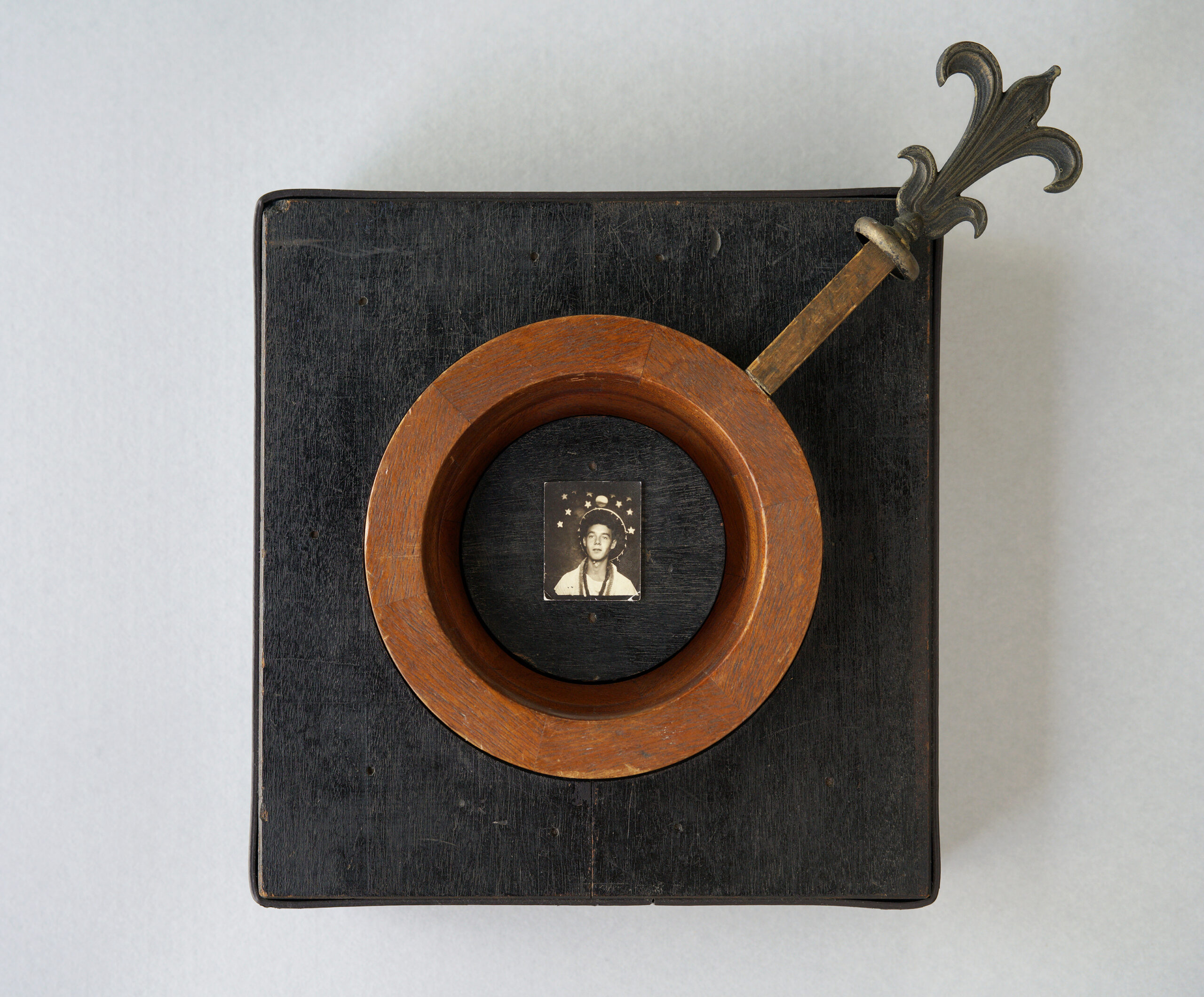
This is one of the artist’s autobiographical pieces. The artist grew up in the 1950s when the US culture was very cowboy/cowgirl centric, with country swing music playing on the radio and primarily Westerns (cowboy vs. Indians) playing on the then relatively new invention of TV. As such, the kind-hearted, masculine cowboy became the artist’s male role model and ideal, which was also true for most American boys from that time period. However, the artist felt that he was somehow different from his other young male friends. He could not quite figure it out until his hormones finally kicked-in during puberty. It was then that he realized that he not only had an emotional connection to the cowboy but also a sexual attraction.

In this artwork we see that the photograph of the young cowboy is placed in the center of the male gender symbol. However, instead of the arrow tip on the male symbol we see the fleur-de-lis reflecting the artist’s early childhood gut feeling that he was somehow “different,” only later in his teens discovering and coming to terms with the fact that he was a masculine male who was also gay.

The Money Game

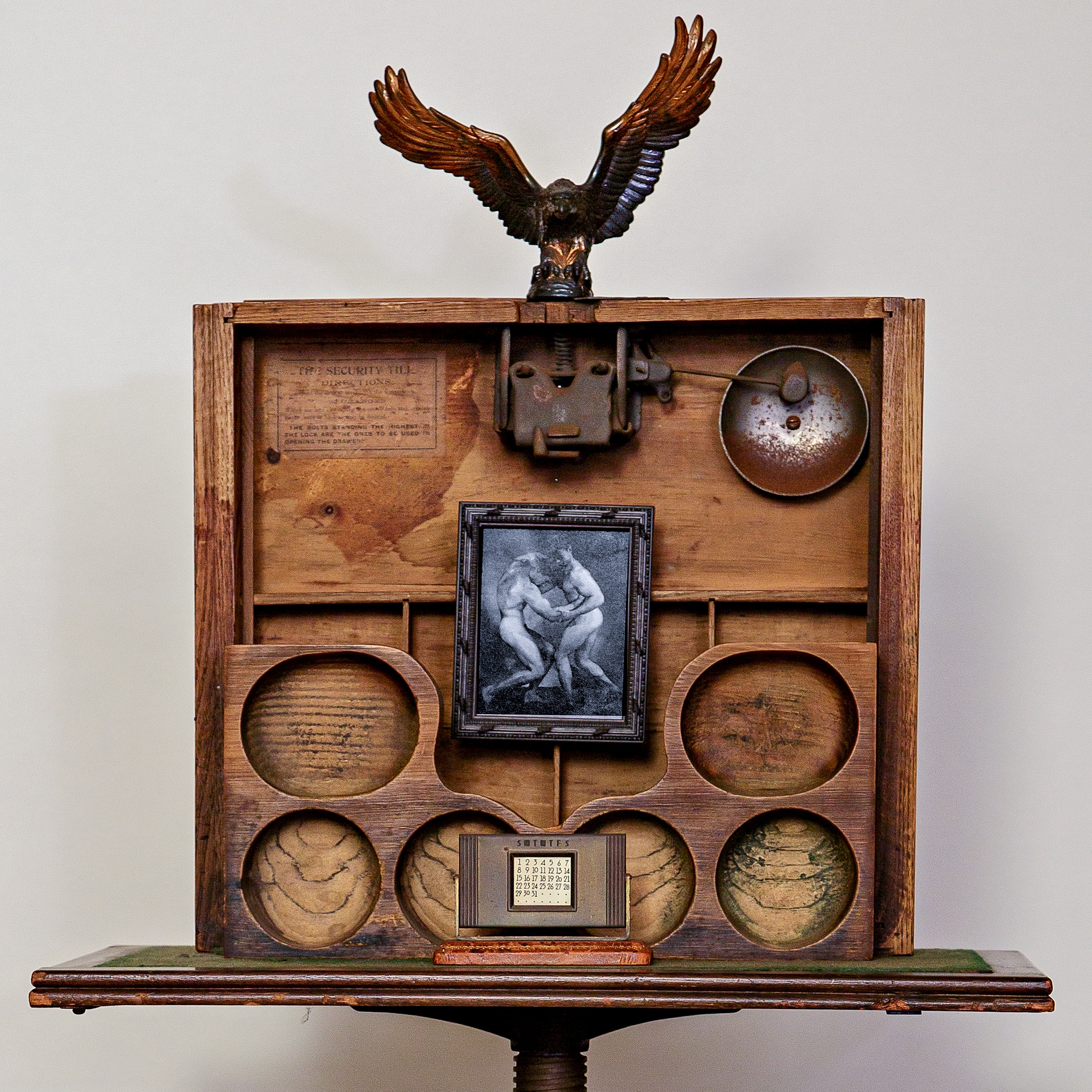
Starting at an early age, boys in the US are trained to be competitive. In school, boys are encouraged to play sports and compete in physical and mental activities. Indeed, PE is a scheduled part of the day in most schools. Competitive games establish winners and “losers.” Competition has fueled human progress and failure. Capitalism is a very competitive game about money, with the extent of the accumulation of money suggesting a male’s dominance/potency.

Here we see competition represented by men wrestling, and the action takes place inside a vintage wood cash drawer. On top sits an eagle, which is a symbol of freedom. However the eagle is also a bird of prey. There was a popular saying from the 1920s – 50s “The Eagle flies on Friday” which reflected the fact that most workers in the USA were paid on Friday….during a time when the 25 cent and 50 cent US coins, as well as the dollar denominated gold coins, featured an eagle. With the use of the calendar and placing it in the foreground, D’Elia is commenting that men seduced by ‘the money game’ may sadly realize later in life the spiritual cost of the game, in that they failed to devote enough quality time, energy and focus to develop and maintain meaningful loving life-affirming relationships.

Time. Traveler.

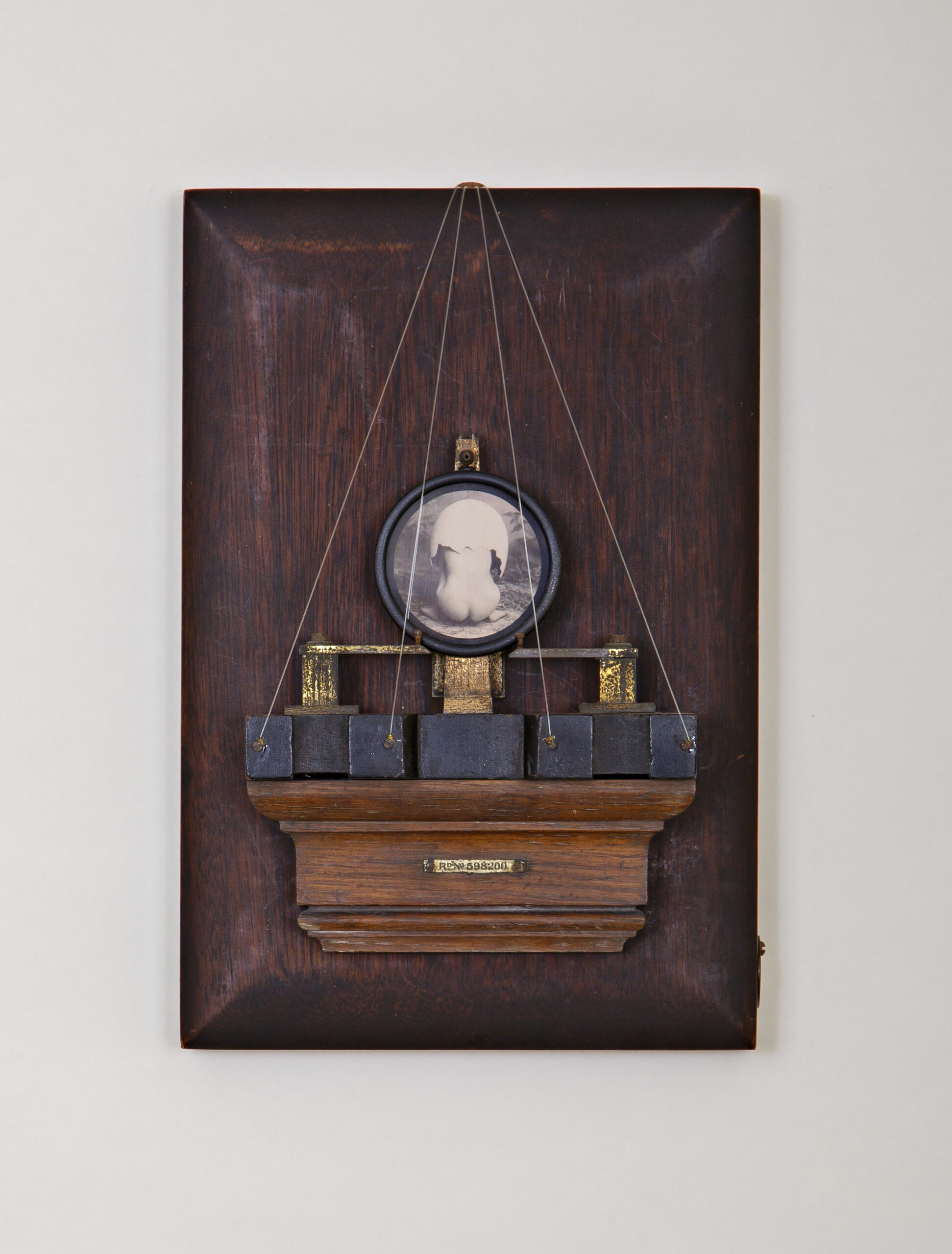
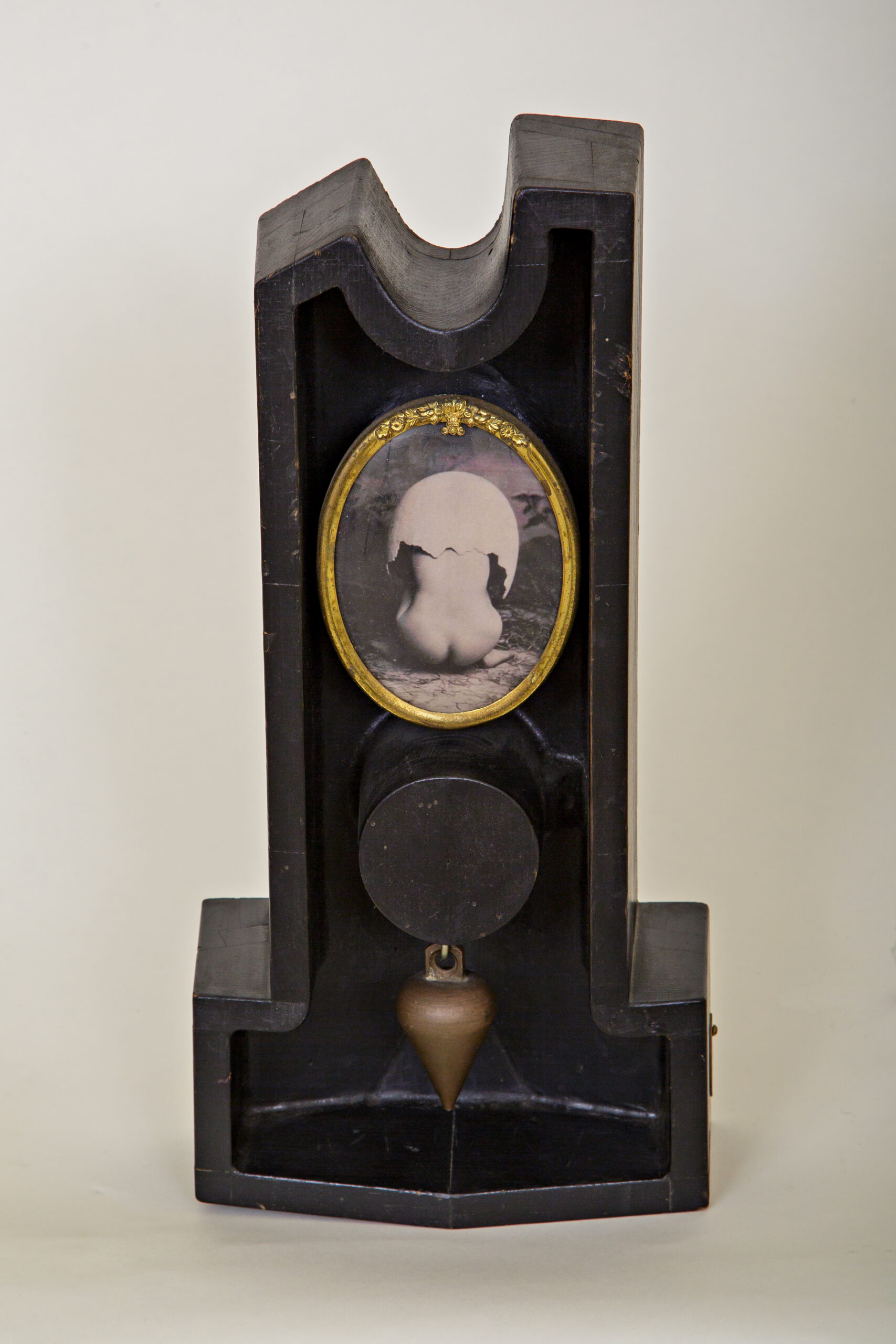
This artwork, featuring a photograph of a human hatched from an egg, is about the fragility of life and the dangers and challenges faced during the journey. We see the use of remnants from an antique weight scale, suggesting the need for a balanced life, as well as the use of fishing line in the form of a sail suggesting a boat sailing through time.

Role. Model.

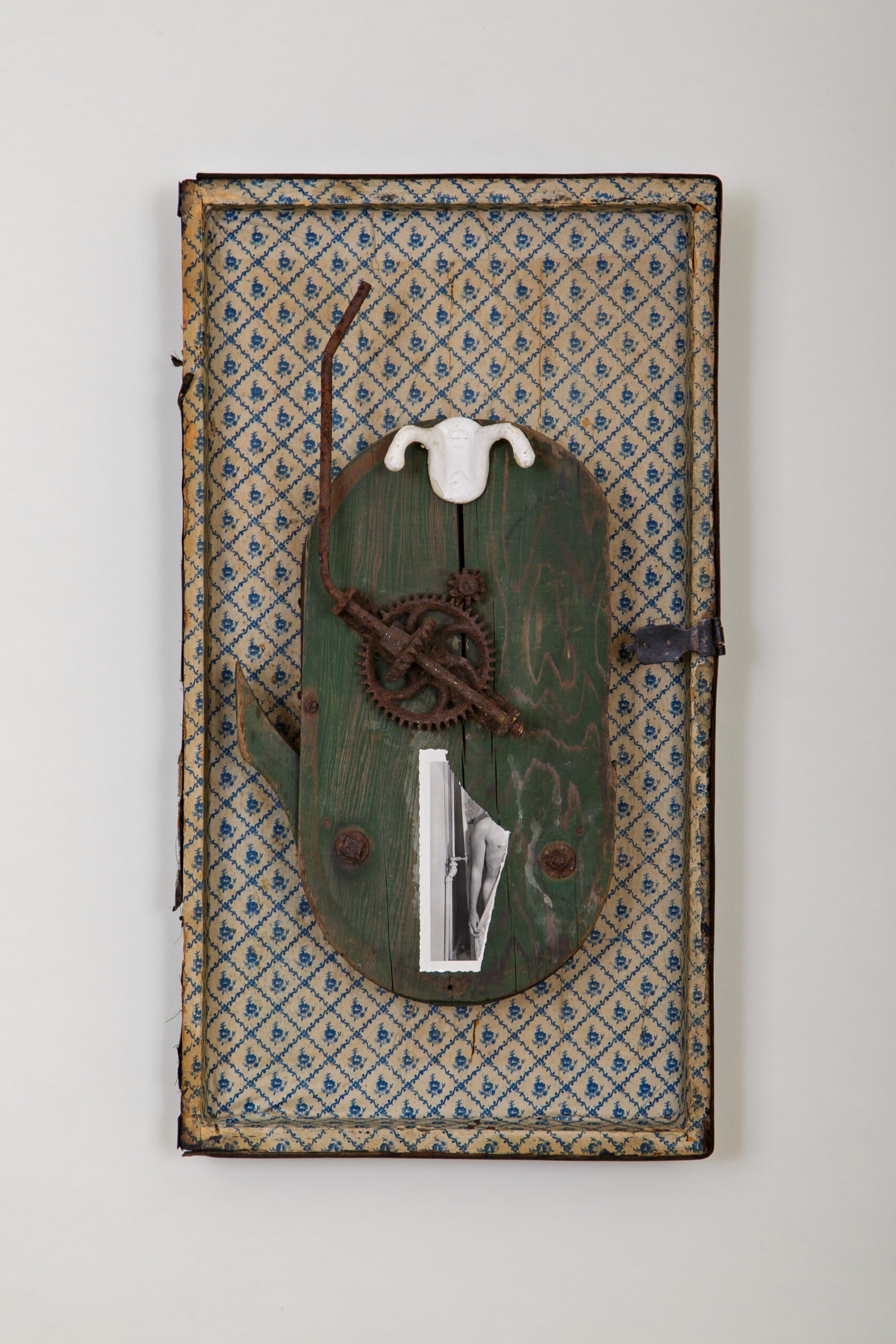
This is the first assemblage artwork created by D’Elia. At the invitation of Susan Tibbles (assemblage-artist/curator), D’Elia was encouraged to start creating art and submit something to the juried “Bull Show” exhibition in Santa Barbara, California. The criteria for entering an artwork was that it had to reference a bull.
D’Elia used an inverted antique coat hook, painted white, to suggest the horns of a bull. D’Elia was awarded the ribbon for “Best Emerging Artist.”

Collection of the artist

Adonis

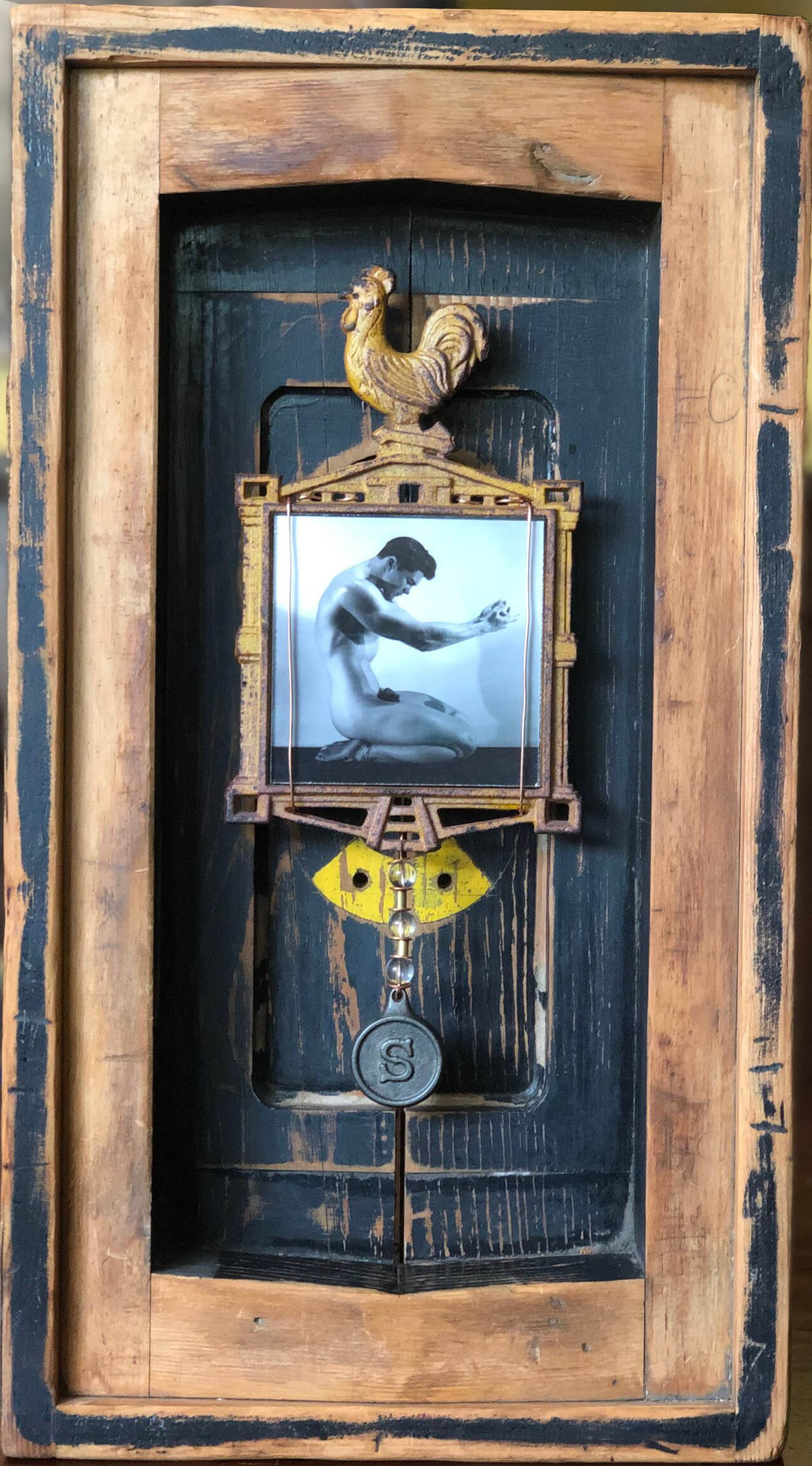
This artwork deals with desire. In Greek mythology, Adonis was the god of male beauty and desire. In popular culture, referring to someone as an Adonis calls attention to their being a very handsome young man.

Here we see a very handsome young man as the source of desire. The photograph is a circa 1950’s vintage physique study, taken by Bruce Bellas (a.k.a. ‘Bruce of Los Angeles’). This now seemingly tame photograph was then considered to be pornography. The photograph is mounted on a trivet. A trivet is an object that holds hot plates slightly above a tabletop to prevent the heat from warping/damaging the tabletop. As we see here the trivet it is still holding a “hot plate,” namely the image of the handsome young man. The artist used a trivet with a rooster atop so that it could be painted gold as a visual pun in reference to ‘the golden cock.’ Dangling from the bottom of the trivet are three glass beads…referring to the three ‘Hail Mary’ beads found at the end of a rosary…suggesting that for most people, it would be from the luck of a ‘Hail Mary’ pass to get this young man’s attention. Timing would be everything. At the end of the beads hangs a Sessions mantle clock pendulum bob embossed with a large letter “S”, which is again a reference to time, but also ‘Sex.’

All In The Family

Child sexual abuse is a crime and has lifetime effects. It includes any interactions between a child and an adult in which the child is used for the sexual stimulation of the perpetrator or observer. Child sexual abuse is often predicated on silencing the victim, maintaining secrecy regarding the relationship, and as a result, reporting and disclosure is low. About 93% of children who are victims of sexual abuse know their abusers. The younger the victim, the more likely it is that the abuser is a family member. Of those molesting a child under 6 years old, 50% are family members. Often the adult family abuser, when caught, will try to avoid responsibility saying they were drunk or high on drugs.

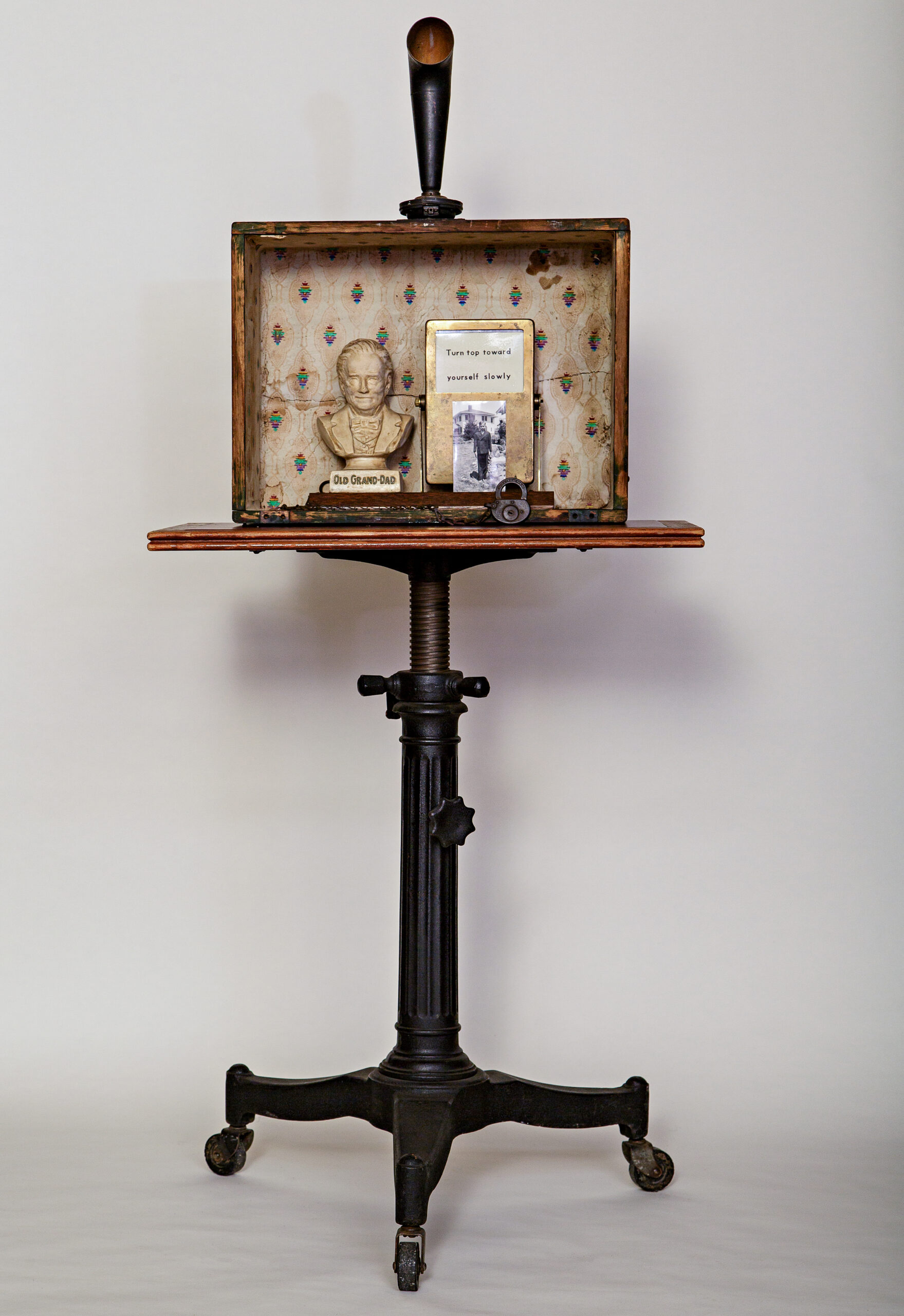
Here we see the perpetrator is the grandfather. The artist uses a store countertop display for the OLD GRANDAD brand of alcohol. The counter display features a flip calendar with instructions to the shop keeper on the backside to ‘turn top slowly toward yourself’ to change the date shown on the calendar – symbolic of what the grandad probably requested of the grandson. There are a couple of lose screws seen at left. The lock and chain represent the power and control the perpetrator has over the victim.

All In The Family

Adoration of the Magi

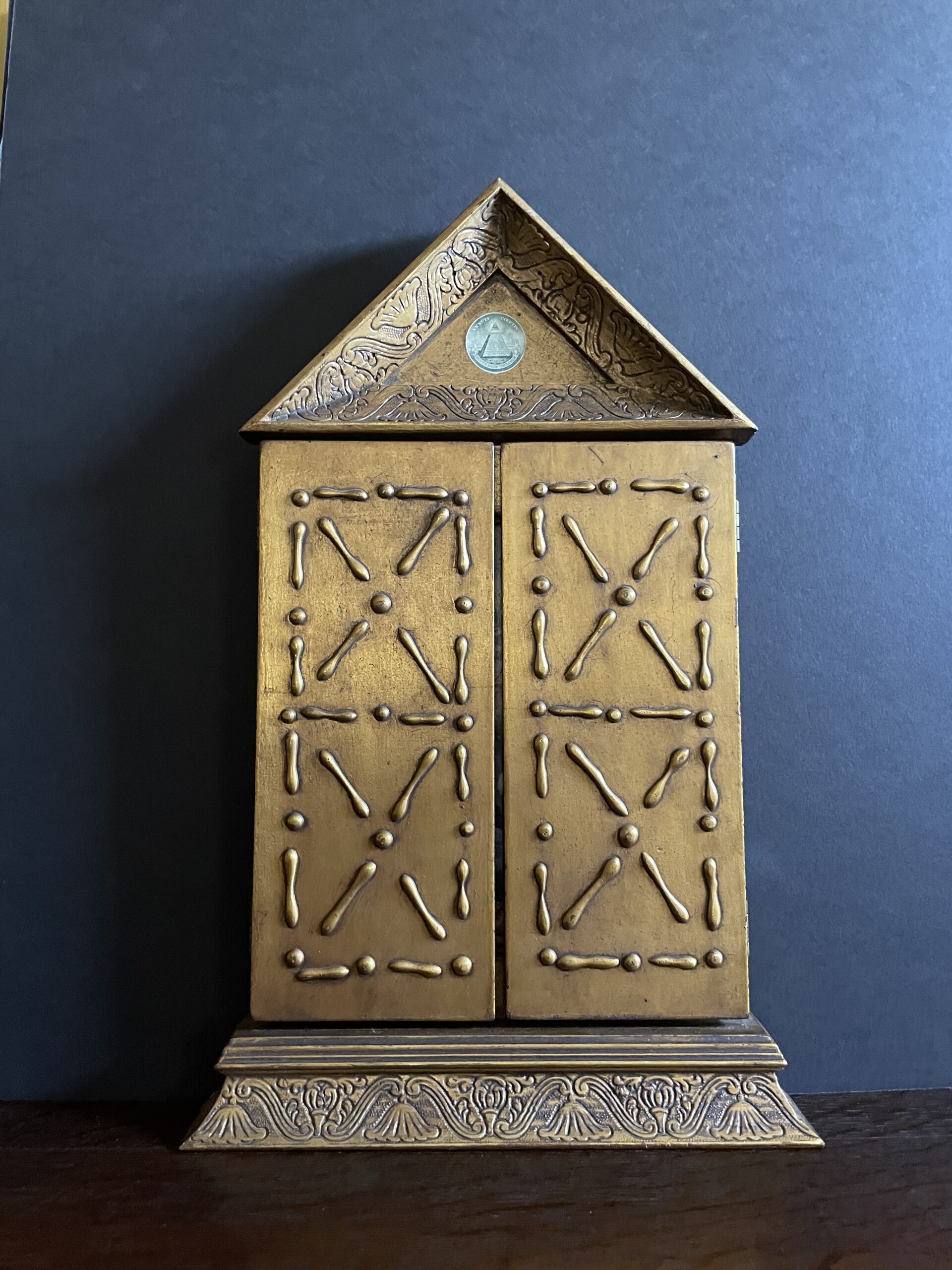
The “Adoration of the Magi” is the name traditionally given to the subject ‘The Nativity of Jesus’ in art in which the three Magi’s (the 3 kings) set out on a journey following a star to find the newborn Jesus so that they can worship him and celebrate his birth with gifts of gold, frankincense and myrrh. The Adoration of the Magi is a favorite subject of Christian art: chiefly painting.

In D’Elia’s version, we see that the three kings quite obviously have arrived several years late. The secondary title to this artwork is ‘Better Late Than Never’ suggesting that finding a spiritual connection is welcomed whenever or where ever it happens.

Come All Ye Faithful

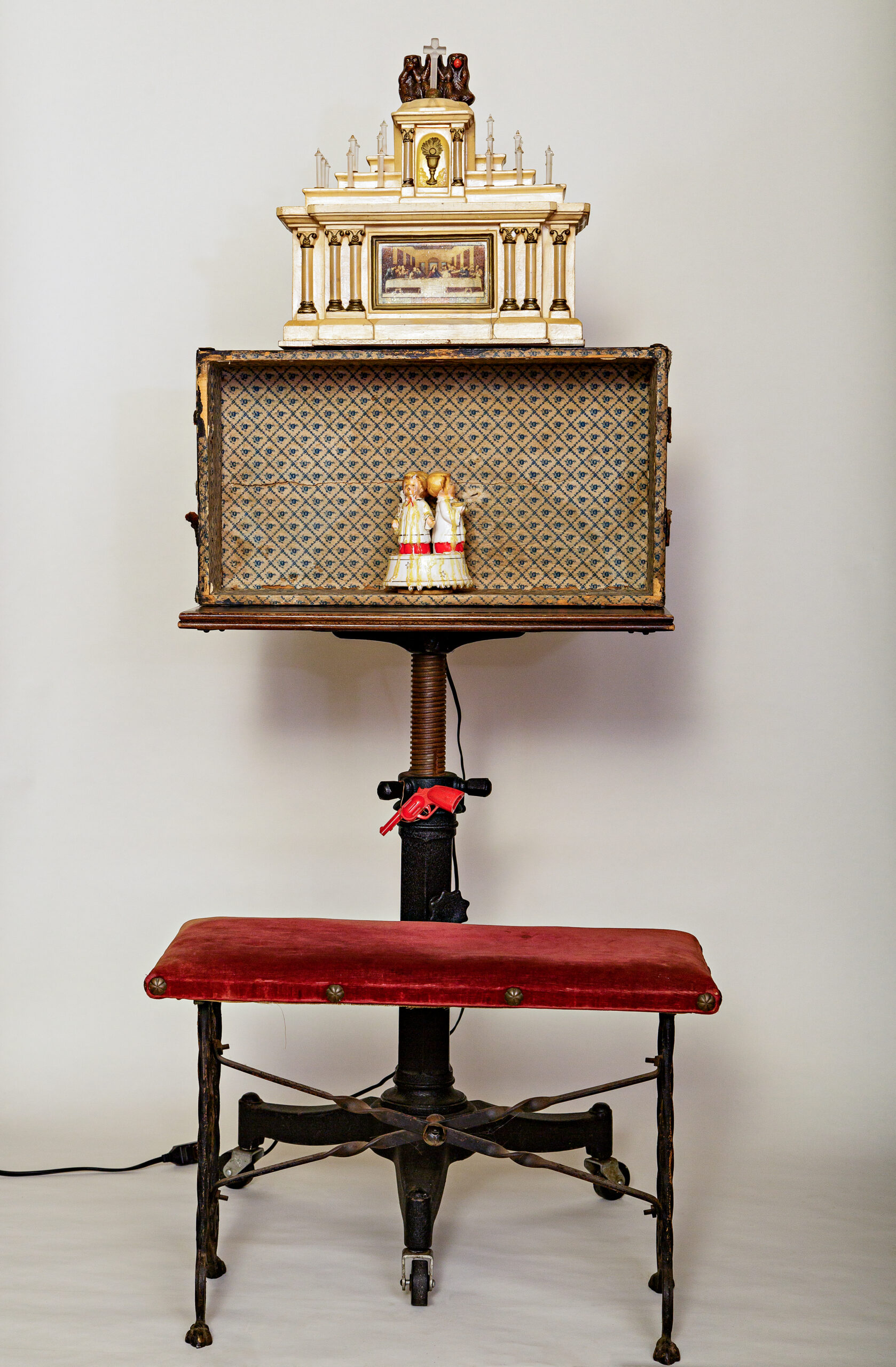
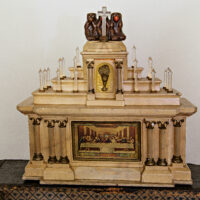
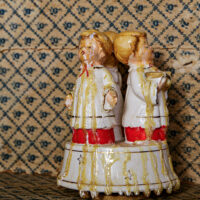
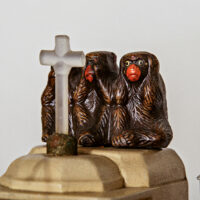
This piece is a commentary on the ongoing molestation allegations against priests and other trusted clergy. Here we see a brightly lit altar top, with candles glowing. On top of the altar sits a figurine of the ‘three wise monkeys’ hiding behind a cross, reflecting a stance of “speak no evil, see no evil, hear no evil.” Below this devotional scene we view a dimly lit space (made from the bottom half of an old wallpapered suitcase), suggesting decay, neglect, abandonment. In this dingy recess we see three choirboys. Looking more closely at the choirboy figurine it becomes obvious what has happened to them. (BTW, the choirboy figurine is actually a music box that when rotated and wound up plays the tune, “Come All Ye Faithful”). The deep red velvet covered iron bench in front of the artwork further suggests being in church. Below the table top, and somewhat hidden, we see a small plastic gun pencil sharpener. Children who have been molested are eight to ten times more likely to commit suicide than non-abused children.

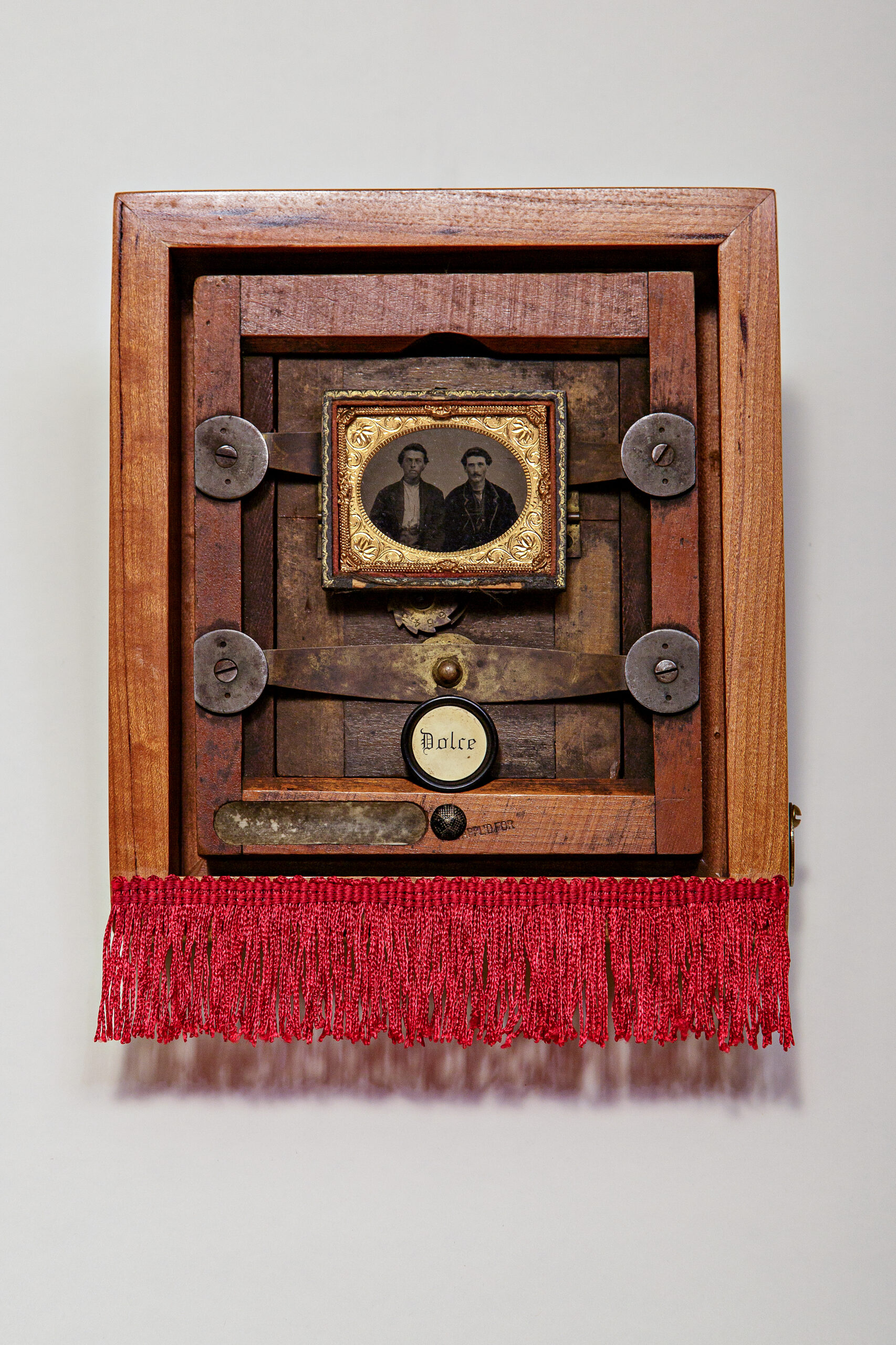
Dolce

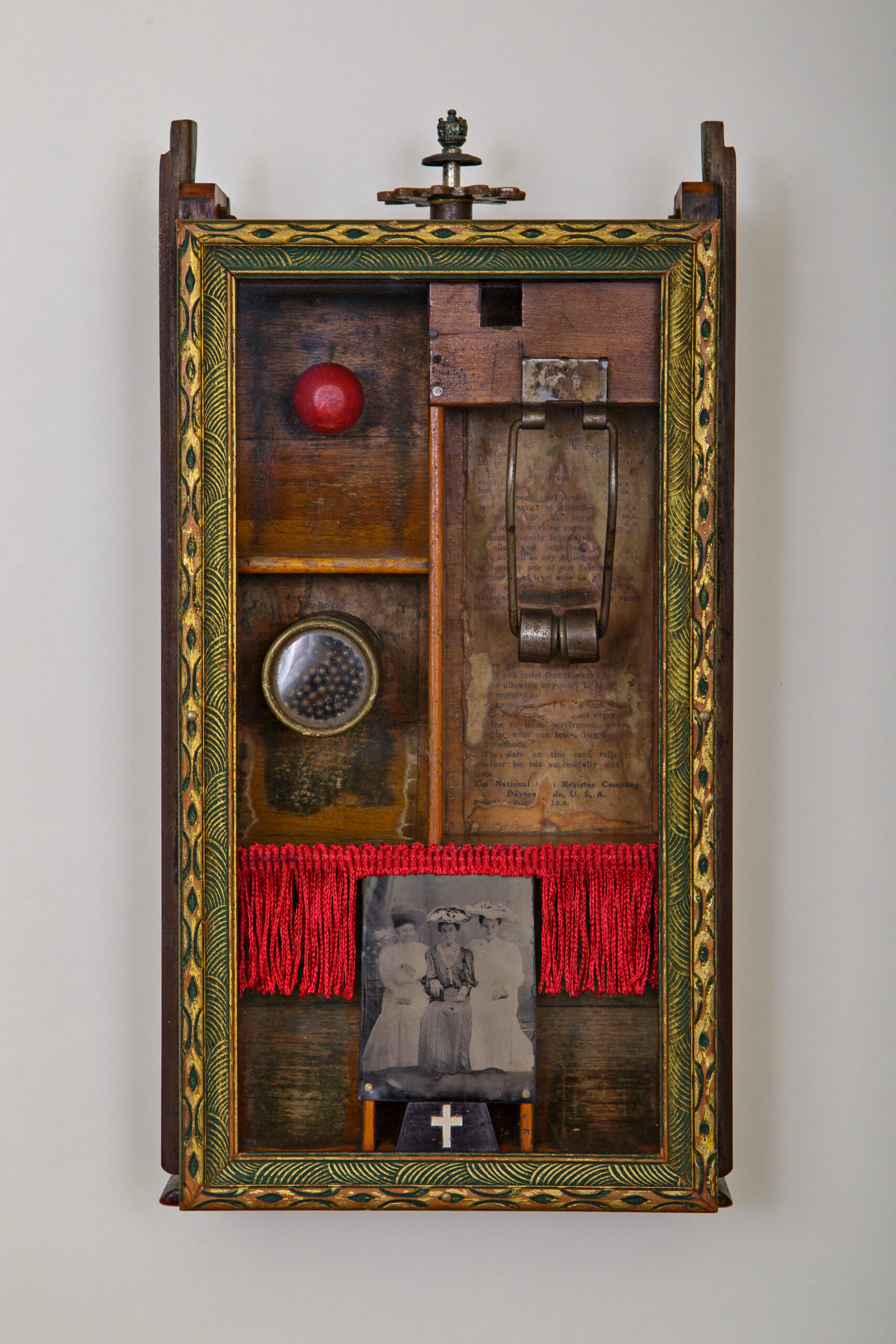
This piece shows a male couple circa early 1870s. One can only imagine how difficult it must have been for them to have a relationship living as a couple. The photograph used in this artwork may be the only evidence that remains of their relationship and life together. Photography was very expensive back in those days and so their documenting their relationship with photography says a lot about their commitment and love for each other. They also had to go to the extra effort and perhaps risky effort to locate a photographer who would agree to take their photo.

This artwork is made using an antique photography contact printing frame as the base, and also uses a pump organ voicing knob as a visual pun for the bully derogatory term, ‘organ puller.’ The red cloth fringe references the Victorian times when this couple lived. Dolce translates to “sweet,” likely reflecting the tone of their relationship.

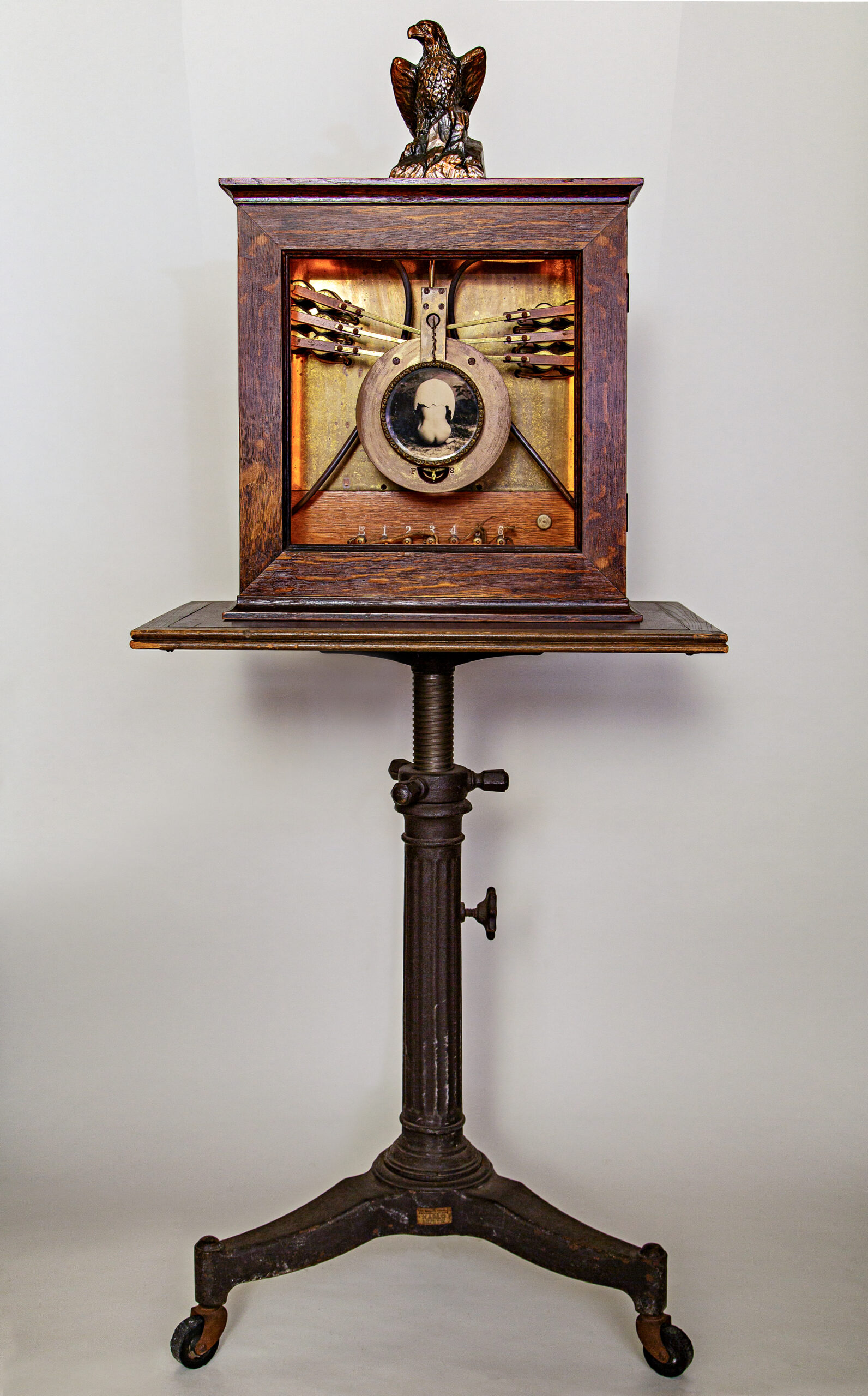
Fragile. Choices.

This artwork is about the fragility of life and the dangers and challenges faced during the journey. There is a somewhat hidden copper key hanging inside the oak cabinet reflecting that one can chose to exit life at any time.

This artwork is part of D’Elia’s ‘Rolling Conundrum’ series. The rolling conundrums are artworks created to represent challenges that confront us everywhere in the world.

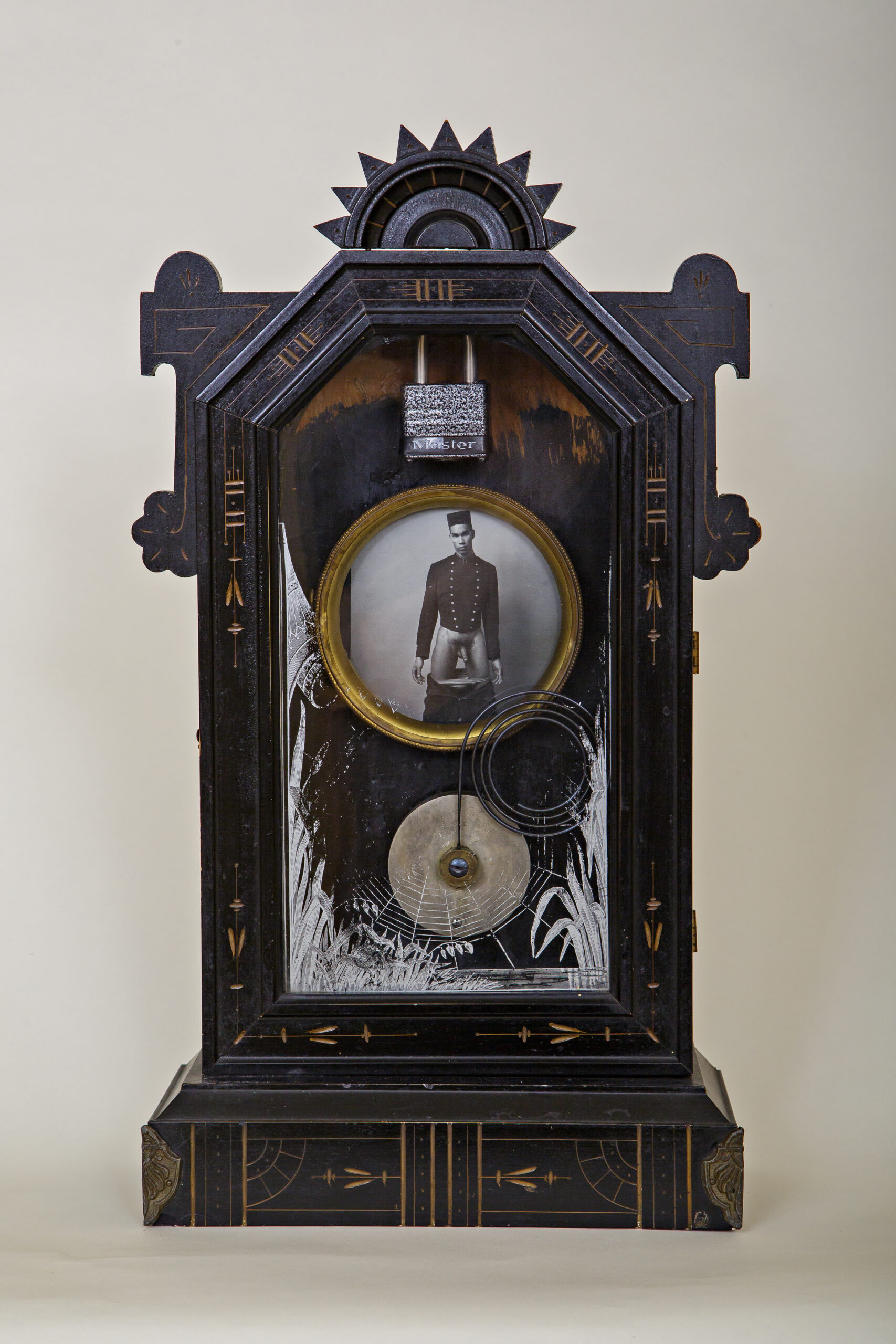
Master

D’Elia’s assemblage Master confronts the layered history of servitude, sexuality, and power with the precision of a psychological excavation. The work inhabits a Victorian-era clock case, its ornate geometry repurposed as a vessel for cultural memory and critique. Time, here, is both container and witness, its face replaced by a haunting photographic image of a young, nude African American bellhop. The figure stands rigid in his livery, a uniform of service, yet his nakedness transforms him into an object, stripped of agency, reduced to spectacle.

The image is encircled by a halo-like gold ring, once the face of the clock. Rather than sanctifying the figure, this golden halo emphasizes the uneasy contradiction between reverence and exploitation. Above it hangs a cold, functional padlock branded Master, a blunt symbol of control, ownership, and the denial of freedom. The word itself resonates with the vocabulary of slavery, echoing centuries of racial domination, while simultaneously evoking the eroticized trope of the “master–servant” dynamic.

D’Elia deepens this uneasy tension with his subtle interventions on the glass. Painted cobwebs sprawl across the surface, suggesting time’s accumulation, the entrapment of history, and the persistence of systemic injustice. The webs also speak to psychological stagnation: traumas left unacknowledged, silenced but still present. Within this suspended moment, the clock no longer measures hours but bears witness to the endurance of a racialized past.
At its core, Master operates as a meditation on objectification and memory. The Victorian clock case, an artifact of respectability and domestic order, becomes the stage for unsettling truths. By encasing the bellhop within this frame, D’Elia reveals how Black male bodies have been historically circumscribed by narratives of labor, service, and erotic projection. Yet the work is not merely accusatory; it holds space for resistance. The figure’s upright stance, his direct gaze, suggests an enduring humanity that refuses complete erasure.
The result is a psychologically charged tableau: a work that collapses histories of slavery, minstrelsy, and fetishization into a single haunting image. Master insists we confront the ways in which race, desire, and power remain entangled, as persistent as the cobwebs across its glass, reminders that the past is never past, but locked into the very structures of our present.